Diagnosis / Espresso / Dialing In
Espresso Extraction Troubleshooting Guide
Espresso is coffee's most technical discipline. Variations of just a single second or one micron in grind size transform a sweet, balanced shot into a harsh, sour, or bitter brew. Learn to read your extraction's visual cues and dial in your recipe step by step.
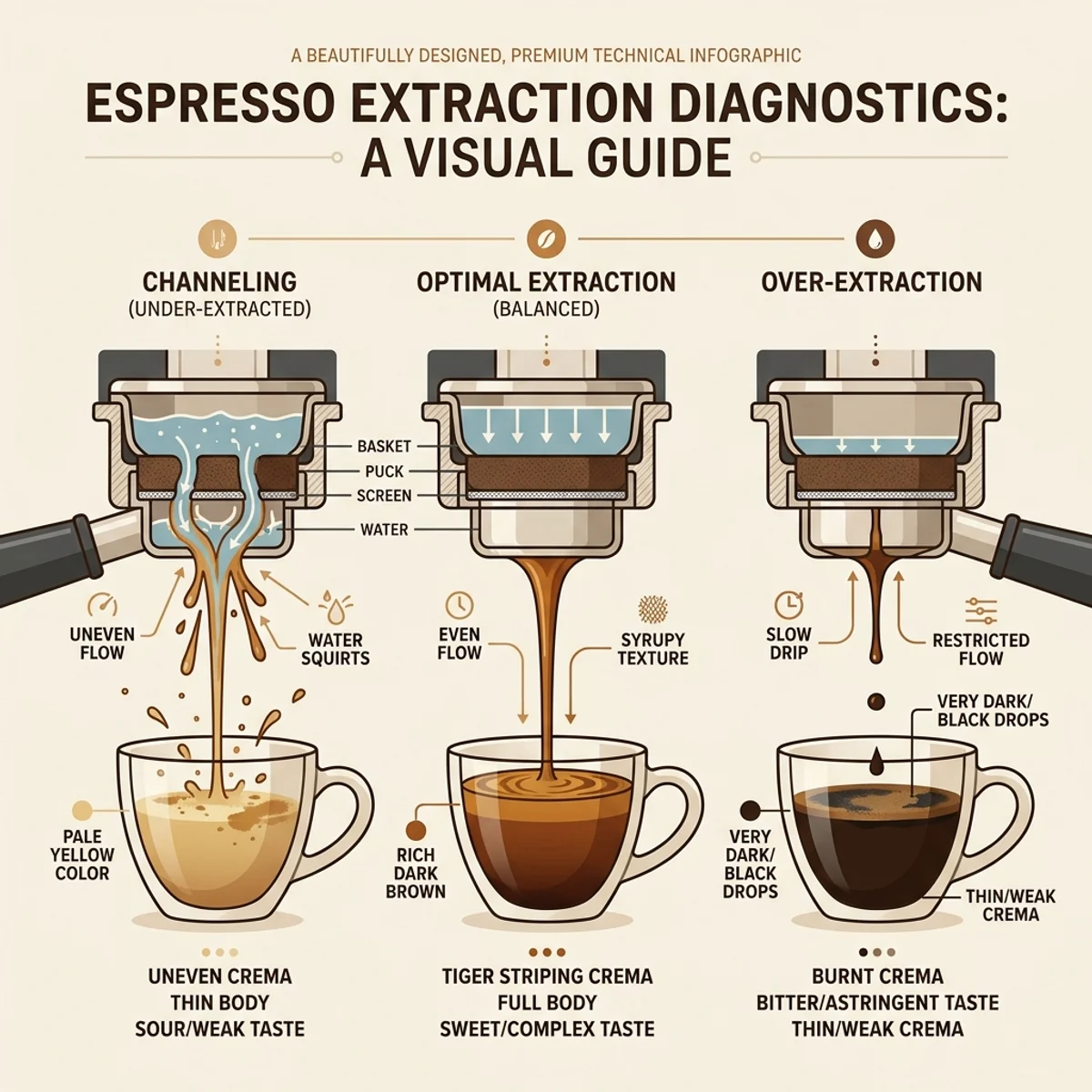
The Physics of the Coffee Puck
When you activate your espresso machine, around 9 bars of pressure push hot water through a tightly compacted "puck" of ground coffee. If the coffee particles are distributed evenly and have the right size, the water flows through them uniformly, dissolving first the **acids**, then the **sugars and aromatic oils**, and finally a controlled amount of **bitter compounds**. If the puck's resistance is uneven, you will run into espresso's three main extraction flaws: under-extraction, over-extraction, and channeling.
Quick Troubleshooting Matrix
Use this table to diagnose your shot by taste and visual indicators before making major recipe changes.
| Shot Appearance / Flow | Probable Diagnosis | Physical Cause | Recommended Solution |
|---|---|---|---|
| Flows in under 20s. Sour, salty taste, thin crema. | Severe Under-extraction | Grind is too coarse; insufficient resistance. | Grind finer; increase dose (+0.5 g). |
| Slow drips or no flow at all. Bitter, dry, and astringent taste. | Severe Over-extraction | Grind is too fine; water flow is blocked. | Grind coarser; reduce brew time. |
| Spurting sprays, uneven flow, early blonding. Tastes sour and bitter at once. | Channeling | Puck cracked due to clumps or tilted tamping. | Use WDT tool; tamp perfectly flat; do not tap portafilter. |
| Good flow and time but watery mouthfeel and low intensity. | Low Concentration (Low TDS) | Ratio is too long or coffee grind is loose. | Shorten ratio (e.g., from 1:2.5 to 1:2) or use fresher coffee beans. |
| Correct flow rate and time but crema dissipates immediately. | Stale or Degassed Coffee | Lack of CO₂ remaining in the beans. | Use coffee roasted between 10 and 45 days ago. |
Flaw 1
Under-extraction: The Sour, Salty Espresso
Under-extraction happens when the water washes through the coffee puck without dissolving the desirable sweet compounds. The easiest parts of the bean to dissolve are the sour organic acids and salts. If you stop the shot too early or the water runs too fast, you only extract these initial compounds, leaving you with an **unpleasantly sour, sharp, and empty cup**.
💡 Checklist to Fix Under-extraction:
- Grind finer: Finer grinds increase contact surface area and slow down the water flow.
- Increase dose: Adding 0.5 g of coffee to the basket (without overloading it) increases puck resistance.
- Raise temperature: If your machine has a PID controller, increase water temperature by 1 to 2 °C to boost solubility.
- Lengthen the ratio: If your standard recipe is 1:2 (18g in, 36g out), let the shot run to 1:2.2 (40g) to allow late-extracting sweet sugars to dissolve.
Sour vs. Acidic: Learn the Difference
A bright, juicy acidity is a hallmark of high-quality, light-roasted Arabica coffees. However, pleasant acidity hits the sides of your tongue, evokes ripe fruit, and is accompanied by sweetness.
The sourness of under-extraction hits the front and center of the tongue, feels sharp and astringent, causes uncomfortable salivating, resembles lemon juice concentrate, and leaves a metallic or salty aftertaste with a watery texture.
Astringency and Dryness
When coffee is over-extracted, the water starts dissolving wood-like fibers and tannins from the bean cells. This produces a tactile sensation called astringency.
Astringency is not just a taste, but a physical feeling: your tongue feels completely dry, rough, and sandpapery, similar to when you drink over-steeped black tea or chew on a grape seed. If your espresso makes you crave a glass of water immediately to wipe away the dryness, you are over-extracting.
Flaw 2
Over-extraction: The Bitter, Dry Espresso
Over-extraction occurs when water extracts heavy, bitter compounds that should remain trapped inside the grounds. It is marked by a **harsh bitterness, ash or carbon notes, and a dry, rough texture in the throat**. It is often paired with long extraction times (over 35-40 seconds) due to excessive puck resistance.
💡 Checklist to Fix Over-extraction:
- Grind coarser: This creates larger channels for water to pass, shortening the total contact time.
- Shorten the ratio (Stop the shot earlier): If you were extracting 40g of espresso from 18g of coffee, cut the shot at 32g or 34g to avoid the final bitter compounds.
- Lower water temperature: Especially helpful with dark roasts. Lower the PID to 90 °C or 91 °C.
- Do not over-tamp: While tamping has a physical compaction limit, ensure you aren't applying excessive force if your grind is already very fine.
Flaw 3
Channeling: The Invisible Enemy of Espresso
Under high pressure, water always searches for the path of least resistance. If the coffee puck has cracks, low-density spots, or large clumps, the water will burst through opening a narrow tunnel (a channel). The result is devastating: the water passing through the channel over-extracts the surrounding coffee (adding bitterness and dryness), while the rest of the puck is under-extracted (adding sour sharpness). **Your shot will taste both sour and bitter at the same time.**
How to Detect Channeling?
If you are using a standard closed portafilter with spouts, channeling is hard to spot directly, though you will notice the shot running suddenly fast and the crema turning thin with light spots.
With a bottomless (naked) portafilter, the diagnosis is immediate: you will see sudden streams of coffee spraying out at odd angles, dry spots on the basket mesh, or a rapid blonding of the liquid in one specific area.
How to Prevent Channeling?
The solution is not to grind finer or tamp harder. The secret is puck uniformity.
- Use a WDT Tool: Combing the coffee with thin needles (0.35 mm) from the bottom of the basket breaks up microscopic clumps and redistributes the grounds.
- Tamp perfectly level: Rest the tamper flat on the basket and push down horizontally. A tilted tamp creates a thin side where water will escape.
- Avoid physical shocks: Never tap the side of the portafilter with the tamper after you have pressed the puck. Doing so separates the coffee from the metal walls and creates an instant perimeter channel.
Corrective Gear
Key Tools to Solve Extraction Flaws
To dial in an espresso consistently, you need tools that eliminate variables and guesswork.
Frequently Asked Questions
Common Questions on Extraction & Calibration
Why does my espresso extract too fast and taste sour?
This is a symptom of under-extraction. The water flows too quickly through the coffee puck because it meets too little resistance. The primary solution is to grind finer. You can also increase the coffee dose by 0.5 grams or increase the water temperature if your machine has PID control.
What is channeling and how do I detect it?
Channeling occurs when high-pressure water cracks the coffee puck and takes the path of least resistance, bypassing sections of the coffee bed rather than flowing through it evenly. It is visually detected using a bottomless (naked) portafilter by thin spurts spraying sideways, uneven flow patches, and a rapid transition to a pale watery stream (blonding).
How does WDT (needle distribution) help prevent channeling?
WDT (Weiss Distribution Technique) uses thin stainless steel needles (~0.35 mm) to comb the coffee grounds in the basket before tamping. This breaks up microscopic clumps generated by the grinder and distributes the particles evenly, eliminating dense zones and air pockets that would otherwise crack under high pressure.
Why does my coffee taste bitter and dry at the back of my mouth?
This is a symptom of over-extraction. Heavy, astringent compounds have been dissolved from the coffee grounds. This happens due to grinding too fine, using water that is too hot, or extracting a yield that is too large (long ratio). The solution is to grind coarser or stop the extraction a few seconds earlier (reduce the recipe ratio).
Master Guide
Return to Espresso Preparation
Apply these diagnostics to your home routine to achieve the sweet, thick, and aromatic espresso you seek.