Budget / Espresso / Barista Gear
How Much Does a Home Espresso Setup Cost?
Brewing real espresso at home is a rewarding hobby, but it requires highly specific gear. We analyze the true start-up costs and break down three typical budgets (Budget, Intermediate, and Advanced) so you can invest smartly without surprise expenses.
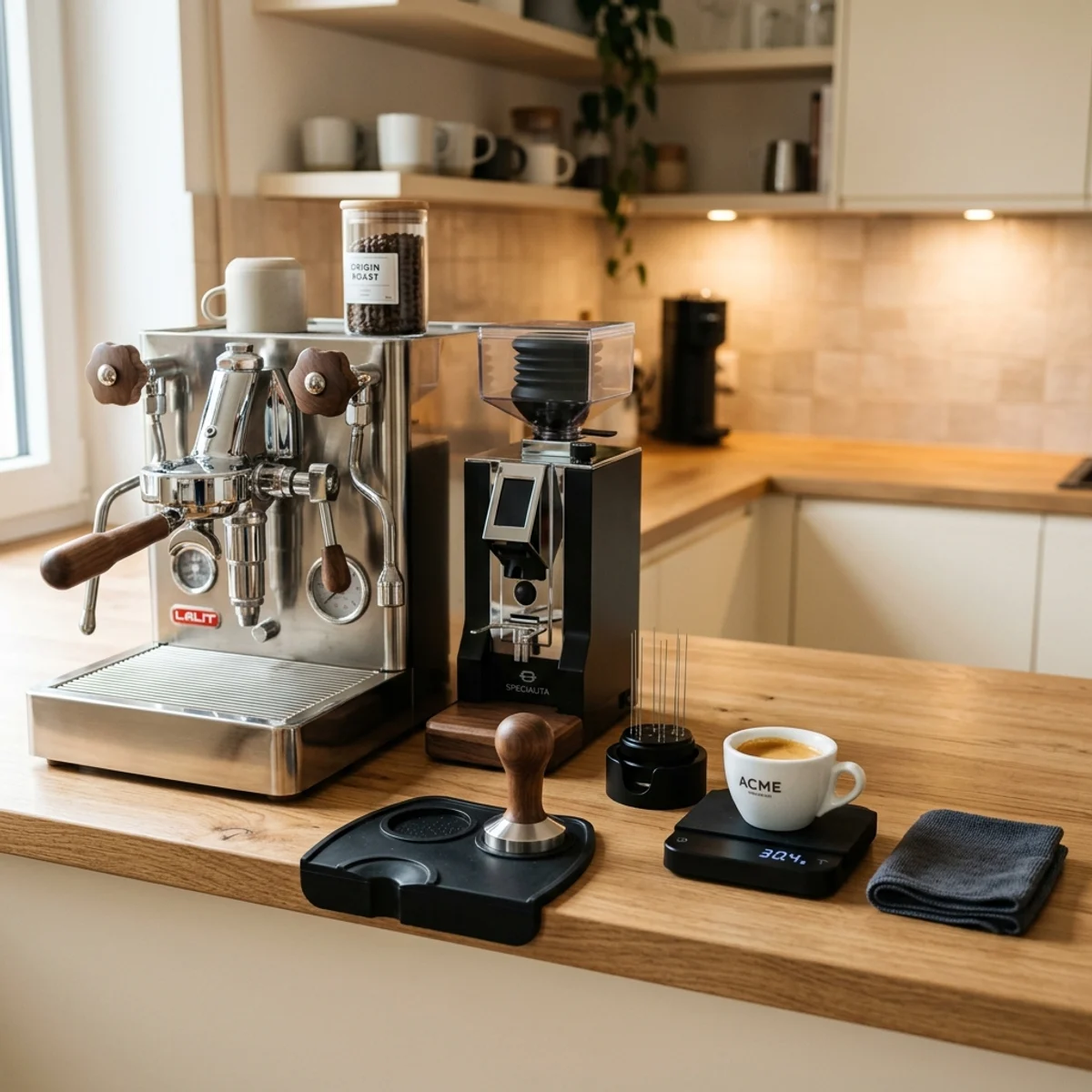
The Golden Rule: Don't Spend Everything on the Machine
The most common beginner mistake is buying a 500€ espresso machine and feeding it store-bought pre-ground coffee or grinding with a 20€ blade grinder. Pressurized water always finds the path of least resistance (channeling); without a microscopically uniform grind, your shot will taste sour and bitter. A real espresso setup relies on **four pillars**: the machine, the micro-adjustable grinder, distribution tools (scale, WDT, tamper), and maintenance (water and cleaning).
Espresso Setup Budgets at a Glance
Quick summary of the three recommended configurations based on budget, barista profile, and cup expectations.
| Profile / Setup | Approx. Investment | Suggested Machine | Suggested Grinder | Included Accessories | Cup Quality / Control |
|---|---|---|---|---|---|
| 1. Budget / Entry-level | 180€ - 210€ | De'Longhi Dedica EC685 or Krups Virtuoso | KINGrinder P2 (Manual) | Factory plastic tamper, basic kitchen scale, DIY WDT. | Basic. Decent flavor using pressurized baskets; honest starting point. |
| 2. Recommended / Intermediate | 480€ - 580€ | Sage Bambino (standard) | Baratza Encore ESP (Electric) or KINGrinder K6 (Manual) | Scale with timer, fine needle WDT, self-leveling tamper, single-wall basket. | Excellent. Allows extracting real specialty espresso with digital PID stability. |
| 3. Enthusiast / Advanced | 1,100€ - 1,400€ | Gaggia Classic Pro or Lelit Victoria PL91T | Eureka Mignon Manuale or DF64 Gen 2 (Electric) | Bottomless portafilter, VST/IMS basket, premium scale, calibrated tamper, water filter pitcher. | Professional. Full control over PID temperature, 9-bar pressure profiling, and dry steam. |
Detailed Breakdown
Analyzing the Three Investment Levels
Budget / Entry-level Setup (<200€)
Ideal for anyone wanting to step up their daily morning coffee without diving into high technical complexity. This setup uses factory pressurized baskets that forgive minor grind imperfections and tolerate fresh supermarket coffee.
- Espresso Machine: De'Longhi Dedica EC685 (~130€-140€)
- Ultra-compact machine with fast thermoblock heating that gets the job done for beginners.
- Grinder: KINGrinder P2 (~45€) or Graef CM 702 (~110€)
- The manual P2 grinder offers steel burrs capable of grinding fine enough for espresso at a fraction of the electric price.
- Minimum Accessories: Digital Kitchen Scale (~12€)
- Weighing the inputs and outputs is necessary even in this range to avoid watering down the coffee.
✗ Contra: Foamy cream texture; flat flavor profile with complex specialty coffees.
Specialty Coffee / Intermediate Setup (~500€ - 600€)
The sweet spot for enjoying real specialty coffee. Here we abandon pressurization: backpressure is created by the coffee bed itself. It requires a more precise grinder and distribution tools, but rewards you with a sweet, thick, and nuanced double shot.
- Machine: Sage Bambino or Bambino Plus (~299€ - 340€)
- Digital PID temperature stability and automatic low-pressure pre-infusion. Includes single-wall baskets.
- Grinder: Baratza Encore ESP (~180€) or KINGrinder K6 (~99€)
- The Encore ESP features micro-adjustments specific to espresso dialing. The manual K6 is the ultimate all-rounder grinder.
- Essential Barista Accessories (~80€):
- Digital scale with timer (0.1g resolution), needle WDT distribution tool (0.35mm) to prevent channeling, and a heavy metal tamper.
✗ Contra: Learning curve is required (mastering WDT distribution and grind dialing).
Enthusiast / Advanced Setup (>1000€)
For hobbyists looking for precision control. The machinery is built with heavy metal, commercial-grade parts, letting you regulate internal pressure to exactly 9 bars, stabilize temperature degree by degree, and steam milk with dry commercial power.
- Machine: Lelit Victoria PL91T or modified Gaggia Classic Pro (~650€ - 800€)
- Brass boiler with high thermal mass and PID display to adjust temperature based on bean roast level.
- Grinder: Eureka Mignon Specialita or DF64 Gen 2 (~420€ - 460€)
- Large flat burr electric grinders (55mm or 64mm) with near-zero retention and consistent output.
- Premium Accessories (~150€):
- 58 mm bottomless portafilter, precision basket (IMS/VST), spring-loaded self-leveling tamper, and active water filtration.
✗ Contra: High upfront cost; longer pre-heating time (15-20 minutes).
Real Budgeting
The Indispensable Hidden Costs
Many buyers empty their wallets on a fancy machine and forget that there are other essential parts of a functioning coffee bar. Account for these initial extra expenses:
1. Water Treatment (~20€ - 50€): Espresso is 90% water. If you use hard tap water, limescale will scale up boiler heating elements and ruin extraction flavors. You need a filter pitcher (like Brita) or bottled water with low mineralization (dry residue < 50 mg/L).
2. Cleaning & Descaling (~15€): Coffee oils burn and turn rancid in the group head shower screen. You need backflush cleaning powder (like Cafiza) and group brushes to keep gaskets clean.
3. Precision Accessories (~40€ - 80€): A needle WDT tool and a digital timer scale are not luxury gadgets; they are the tools that guarantee consistency. Without them, dialing in will be pure guesswork.
⚖ How Much Do Coffee Beans Cost?
One major advantage of home espresso over capsules is the long-term cost per cup.
A bag of high-quality specialty coffee (250g) costs around 8€ - 12€ from a local roaster. With an 18g double-shot dose, you get about 14 shots. This equals 0.70€ - 0.85€ per double shot of single-origin coffee.
Compared to commercial capsules (costing around 0.40€ - 0.50€ for only 5g of stale coffee), brewing fresh beans at home amortizes the equipment cost within a few months of regular drinking.
Compare Grinders
Pick the Right Grinder for Your Setup
Browse our specific catalog guides to find the perfect grinder pairing for your home coffee bar.
FAQ
Frequently Asked Questions on Espresso Budgets
Can I start brewing espresso without buying a grinder?
It is not recommended if you plan on using standard single-wall (non-pressurized) baskets. Pre-ground coffee from supermarkets is ground too coarse, and pressurized water will flush through it in seconds, leading to extreme under-extraction. If you do not have a budget for a grinder, you must use pressurized (dual-wall) baskets, which create artificial backpressure and tolerate commercial pre-ground coffee, though the result will taste flat with foamy cream rather than real crema.
Why does the grinder take up nearly half of the budget?
In espresso, the grinder is actually more important than the espresso machine itself. The machine only pumps hot water under pressure, but the grinder creates the uniform bed of coffee that offers resistance. If the grind size is not microscopically uniform, the water will find cracks (channeling). A poor grinder will ruin the shot on a 1000€ machine, while an excellent grinder can make a 150€ machine shine.
What recurring consumables should I add to my monthly budget?
To protect your equipment and shot quality, you should budget for: water filters or filtering pitchers (limescale ruins boiler elements and alters extraction taste), backflush cleaning powder (like Cafiza to dissolve group head oils), and liquid descaler. This averages about 5€ to 10€ monthly, but prevents costly repairs and stale-tasting shots.
Is it better to buy a machine with a built-in grinder?
All-in-one machines (like the Sage Barista Express) are convenient and save counter space. However, their built-in grinders usually have limited step adjustments compared to dedicated, standalone grinders. Also, if one part breaks, your entire setup goes out of service. Buying a separate machine and grinder makes it easy to upgrade or swap individual parts in the future.
Gear
Explore All Coffee Guru Tools
Use our testing methodology to outfit your kitchen with verified, quality accessories.