Tools / Espresso Machines / Beginner Guide
Best Espresso Machines for Beginners
Venturing into home espresso can be an exhilarating journey or an exercise in utter frustration. Over 80% of beginners struggle with their first shots not because of the machine itself, but due to an invisible trap: using stale supermarket pre-ground coffee, brewing with pressurized baskets without understanding their hydraulic limits, and wrestling with panarello wands that only whip up soapy dish-soap froth.
In this guide, we break down the mechanical principles that genuinely affect cup quality, compare the 4 best entry-level models on the market, and help you choose your first espresso machine based on your budget and ambition.
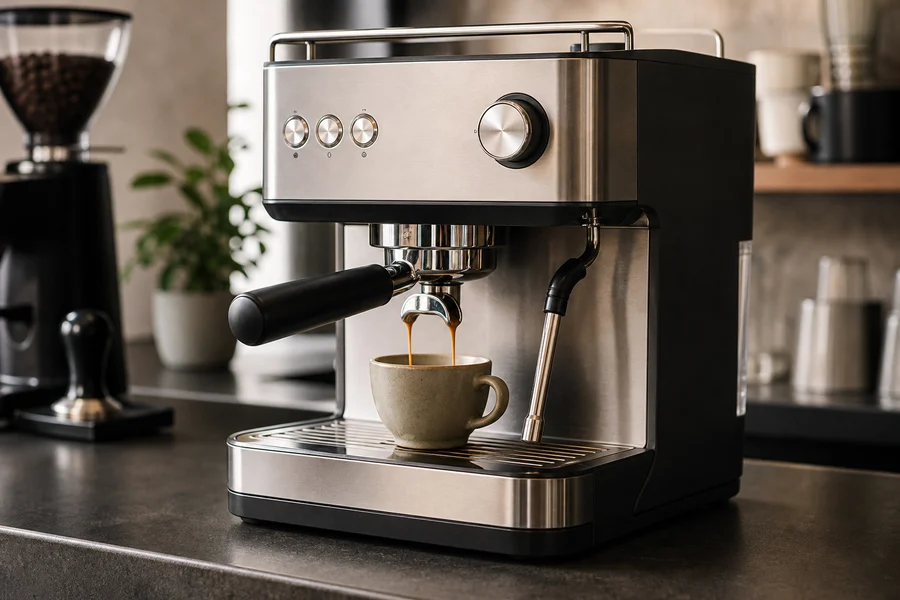
In 30 seconds: which one fits your profile?
If you don't want to get bogged down in technical theory, here is the direct summary to make the right choice:
Sage The Bambino
The undisputed choice if you want to master authentic specialty espresso and pour latte art. Heats in 3 seconds, features a 54 mm group, a commercial-grade steam wand, and includes standard non-pressurized baskets in the box.
De'Longhi Dedica EC685
Just 15 cm wide with an all-metal chassis. Perfect for tight kitchen counters and beginners who want forgiving pressurized brewing first, with the option to customize and upgrade over time thanks to an enormous aftermarket ecosystem.
Krups Virtuoso+ XP442C
Compact brushed stainless steel design with an intuitive 4-button touch interface. Ideal for anyone wanting straightforward espresso without confusing menus or steep learning curves.
De'Longhi Stilosa EC260
The most affordable gateway into manual pump espresso. Features a traditional stainless steel boiler and analog mechanical rotary switch, providing a reliable platform to practice on a minimal budget.
Physical Fundamentals
The 4 Technical Concepts Every Beginner Must Understand Before Buying
The home espresso market is filled with marketing hype ("20 bars of pressure!"). Understanding the physics behind extraction will save you money and disappointment.
1. Pressurized baskets (dual-wall) vs. Standard / non-pressurized baskets (single-wall)
The filter basket where you dose ground coffee is the single most decisive component determining your cup results:
- Pressurized basket (dual-wall): Features hundreds of visible holes inside, but a solid second floor underneath with a single pinhole opening. This pinhole forces coffee through under mechanical back-pressure, whipping air into the liquid to create a thick froth mimicking crema. Advantage: Forgives uneven grind sizes and allows pre-ground supermarket coffee without gushing through. Drawback: The cup tastes flat, muting pleasant acidity and genuine aromatic origin notes.
- Non-pressurized / standard basket (single-wall): Features hundreds of precision laser-cut holes passing completely through. There are no artificial mechanical shortcuts: hydraulic resistance (the classic 9 bars) is generated solely by the uniformly compressed coffee puck itself. Requirement: Demands a burr grinder capable of grinding fine with micrometric adjustment. Reward: Unlocks elastic crema, velvety mouthfeel, and the sweetness of specialty coffee.
💡 When to make the jump? Start with pressurized baskets during your first few weeks. Once you acquire a dedicated coffee grinder, switch to the non-pressurized basket to experience authentic barista extraction.
2. Group and portafilter diameters: 51 mm vs. 54 mm vs. 58 mm
The inner diameter of the portafilter determines the geometry of the coffee puck and accessory compatibility:
- 51 mm (De'Longhi Dedica, Stilosa, Krups): Common in compact entry-level machines. For a standard 14–16 g dose, the resulting puck is narrow and deep. In pressurized mode it works well, but in open non-pressurized baskets that extra depth causes water to find path-of-least-resistance fissures easily, leading to channeling. In return, it enjoys an enormous, very affordable aftermarket accessory ecosystem.
- 54 mm (Sage The Bambino / Breville): Sage's proprietary standard. Offers a wider, well-proportioned puck that balances water penetration depth and surface area. It is widely considered the sweet spot for learning home espresso with high consistency and forgiving tolerances.
- 58 mm (Commercial & prosumer standard: Gaggia Classic, Lelit, E61): The exact diameter found in professional café machinery. The puck is wide and shallow, maximizing surface contact area. It yields the highest potential quality when mastered, but offers zero forgiveness for sloppy distribution or tamping errors.
Check our espresso accessory compatibility guide for exact millimeter measurements of baskets, distributors, and tampers by brand.
3. Thermal systems: Classic Thermoblock vs. Instant ThermoJet vs. Boiler
How the machine heats water dictates how quickly you can brew in the morning and thermal stability across consecutive shots:
- Conventional Thermoblock (Dedica, Krups Virtuoso): An aluminum block with an internal coiled pipe where water heats on demand as it passes through. Takes 30 to 45 seconds to heat up. Inexpensive and nimble, though temperature can dip slightly during consecutive shots.
- ThermoJet (Sage The Bambino): Patented ceramic printed heating system with integrated PID electronic temperature management. Reaches brew temperature in just 3 seconds and transitions from brewing to steaming almost instantly.
- Compact Stainless Steel Boiler (De'Longhi Stilosa): A small pressurized reservoir holding heated water. Delivers stable thermal inertia during extraction, but requires 5 to 8 minutes of warm-up time to thoroughly heat the metal group head.
4. Commercial 1-hole steam wand vs. Plastic Panarello tube
If you enjoy cappuccinos or a silky flat white, the steam assembly is just as vital as the brew group:
- Panarello Tube (Dedica, Stilosa, Krups): A plastic or metal sheath with an air intake hole near the top. It injects air uncontrollably via the Venturi effect. It produces stiff, oversized bubble foam resembling dish soap. While convenient for users who do not want to practice, it completely prevents pouring latte art because the foam sits separated on top of the espresso.
- Commercial 1-hole Steam Wand (Sage The Bambino): A straight stainless steel wand with a precision single-hole tip and no passive air valves. It allows you to stretch milk deliberately at the surface for the first few seconds, then submerge the tip to create a whirling vortex that micro-textures the foam into a glossy, silky wet-paint consistency.
🛠️ Pro tip for the Dedica: Many home baristas remove the outer plastic panarello sleeve and fasten the inner rubber nozzle with a small zip tie. With this simple DIY mod, you can texture milk significantly closer to a commercial wand.
Direct Comparison
Comparison Table: Top 4 Entry-Level Espresso Machines Head-to-Head
We evaluate technical specifications, heat-up times, included baskets, and recommended user profiles.
| Model | Approx. price | Portafilter diameter | Thermal system / Speed | Included baskets | Steam wand | Recommended profile |
|---|---|---|---|---|---|---|
| Sage The Bambino | ~€299 | 54 mm | ThermoJet (3 seconds) | Pressurized & Non-pressurized (1 and 2 cups) | Commercial 1-hole wand | Budding barista: wants to master specialty espresso and authentic latte art. |
| De'Longhi Dedica EC685 | ~€169 | 51 mm | Thermoblock (~35 seconds) | Pressurized (1, 2 cups and E.S.E. pods) | Adjustable Panarello tube | Compact space & modding: small kitchens with room to upgrade through aftermarket accessories. |
| Krups Virtuoso+ XP442C | ~€149 | 51 mm | Thermoblock (~40 seconds) | Pressurized (1 and 2 cups / E.S.E.) | Stainless steel Panarello | Streamlined elegance: straightforward 4-button touch interface and clean stainless steel aesthetics. |
| De'Longhi Stilosa EC260 | ~€91 | 51 mm | Stainless boiler (~5-8 min) | Pressurized (1, 2 cups and E.S.E.) | Traditional Panarello | Strict budget: the best manual pump machine available for under €100. |
In-Depth Analysis
Detailed Analysis of the 4 Recommended Models
We evaluate real strengths, compromises, steam behavior, and verdicts for each machine.
Sage The Bambino
- Group diameter
- 54 mm
- Thermal system
- ThermoJet (3 s)
- Brew pressure
- 9 bars with OPV
- Steam wand
- Commercial wand (1 hole)
- Included baskets
- 4 (dual-wall & single-wall)
- Water tank
- 1.4 L
The Sage The Bambino marks the threshold where home coffee shifts from a frothy substitute into genuine café-grade espresso. Its secret is not an astronomical pressure rating, but the exact opposite: an overpressure valve (OPV) that limits pressure to the optimal 9 bars, preceded by a low-pressure pre-infusion phase that gently saturates the puck at 1–2 bars before applying full extraction flow. Its ThermoJet heating element hits brew temperature in 3 seconds flat, and its manual single-hole steam wand has plenty of velocity to spin milk into a silky vortex for authentic latte art microfoam.
✓ Key Strengths (Pros)
- True 9-bar extraction with low-pressure pre-infusion.
- Instant 3-second heat-up with ThermoJet system and PID control.
- Commercial 1-hole steam wand capable of authentic latte art microfoam.
- Includes both pressurized and standard single-wall baskets in the box.
✕ Limitations to Consider (Cons)
- Lightweight chassis (4.9 kg): requires holding the machine while locking the portafilter.
- Compact drip tray that fills up quickly after steam purges.
- Higher price point that demands a quality burr grinder to unlock its full potential.
De'Longhi Dedica EC685
- Group diameter
- 51 mm
- Thermal system
- Thermoblock (~35 s)
- Pump pressure
- 15 bars
- Steam wand
- Adjustable Panarello tube
- Included baskets
- 3 (pressurized + E.S.E.)
- Width
- Only 14.9 cm
The De'Longhi Dedica EC685 is arguably the most popular entry-level home espresso machine of the past decade. It occupies less than 15 cm of counter width, and its metal body conveys dependable build quality immediately. While stock out of the box it is tailored for pre-ground coffee in dual-wall baskets, its massive global enthusiast community has fostered an endless aftermarket ecosystem: bottomless portafilters, 51 mm competition single-wall baskets, puck screens, and calibrated tampers. It is an unmatched starting platform to upgrade step-by-step as your skills develop.
✓ Key Strengths (Pros)
- Only 14.9 cm wide: fits into any compact kitchen setup.
- Durable metal chassis with fast thermoblock warm-up (~35 s).
- The largest 51 mm aftermarket accessory and modding ecosystem available.
- Frequently discounted with excellent resale value.
✕ Limitations to Consider (Cons)
- Stock Panarello injects excess air, making silky microfoam difficult without modding.
- Narrow 51 mm group: the deeper puck is more susceptible to channeling.
- Included plastic tamper is flimsy (a machined metal tamper is highly recommended).
Krups Virtuoso+ XP442C
- Group diameter
- 51 mm
- Thermal system
- Thermoblock (~40 s)
- Pump pressure
- 15 bars
- Steam wand
- Stainless steel Panarello
- Included baskets
- 2 (pressurized + E.S.E.)
- Interface
- 4-button touch panel
The Krups Virtuoso+ XP442C is an outstanding option for those prioritizing modern design and everyday simplicity. Its brushed stainless steel housing resists fingerprints and integrates seamlessly into contemporary kitchens. The front touch interface discards levers and dials in favor of four responsive buttons with programmable volumetric auto-stop and rapid thermoblock steam activation. It operates cleanly, quietly, and provides great consistency with standard grocery-store grinds.
✓ Key Strengths (Pros)
- Sleek, modern brushed stainless steel design with fingerprint resistance.
- Highly intuitive 4-button touch control panel with auto-stop dosing.
- Fast thermoblock heating and tidy extraction with an ample drip tray.
- Quiet, robust operation for effortless daily brewing.
✕ Limitations to Consider (Cons)
- Smaller ecosystem of compatible custom accessories compared to the Dedica.
- Ships with pressurized baskets only in the original package.
- Steam wand articulation angle is somewhat restricted.
De'Longhi Stilosa EC260
- Group diameter
- 51 mm
- Thermal system
- Stainless boiler (~5-8 min)
- Pump pressure
- 15 bars
- Steam wand
- Traditional Panarello
- Included baskets
- 2 (pressurized + E.S.E.)
- Power
- 1100 W
The De'Longhi Stilosa EC260 proves you do not need to spend €200 to €300 to enter manual pump espresso. Instead of a lightweight flow-through thermoblock, it features a classic stainless steel boiler. While it requires 5 to 8 minutes to heat the boiler and portafilter mass thoroughly, once hot it delivers commendable thermal stability. Its front 3-position rotary selector is straightforward, dependable, and free of complex electronic circuitry prone to failures.
✓ Key Strengths (Pros)
- Unbeatable price: a reliable manual pump machine for under €100.
- 1100 W stainless steel boiler providing stable thermal inertia.
- Direct, ultra-durable mechanical switch with no fragile circuit boards.
- Two-tier drip tray accommodating both espresso cups and tall mugs.
✕ Limitations to Consider (Cons)
- Requires 5 to 8 minutes to thoroughly warm the boiler mass and group.
- Chassis is predominantly lightweight plastic compared to all-metal rivals.
- Basic Panarello wand with modest steam power for latte art.
Complementary Gear
The Essential Beginner Barista Kit: Why the Machine is Only 50% of the Equation
Buying an outstanding espresso machine and feeding it store-bought pre-ground coffee is like putting wooden wheels on a sports car. Here are the accessories that will transform what ends up in your cup.
1. The Burr Grinder: The True Engine of Espresso
In espresso, pressurized water forces its way through the coffee bed in just 25 to 30 seconds. For extraction to be balanced, the grind particles must be microscopic and uniform within tolerances of a few microns. A blade spice grinder or supermarket pre-ground coffee yields uneven particles and fines: water will carve easy channels through fissures, producing coffee that tastes simultaneously sour and bitter.
If you plan to use standard non-pressurized baskets, allocate part of your setup budget for a dedicated coffee grinder or explore our complete catalog of coffee grinders:
- Precision manual grinders (€70–€130): Models like the Kingrinder K2/K6 or Timemore C3 ESP feature conical stainless steel burrs with micrometric clicks capable of matching the grind consistency of €300 electric grinders.
- Dedicated electric espresso grinders (€200–€350): Options like the Baratza Encore ESP or DF54 provide effortless daily workflow and the micro-adjustment range needed to dial in fine espresso with zero manual labor. Explore our full in-depth comparison in our best home espresso grinder guide.
2. The 4 Must-Have Accessories for Under €50
⚖️ Precision Digital Scale (0.1 g)
In espresso, a 0.5 g dosing variance changes extraction time by up to 5 seconds. A digital scale with 0.1 g accuracy and an integrated timer allows you to master exact brew ratios (e.g., 16 g coffee dose in for 36 g espresso out).
🪡 WDT Tool (Needle Distributor)
A small handle fitted with ultra-thin acupuncture needles (0.3 to 0.35 mm) used to stir coffee grounds in the portafilter. It breaks electrostatic clumps and evens out density, eliminating over 90% of channeling.
🔨 Precision Metal Tamper
Discard the flimsy plastic tamper included in the box. A heavy, flat metal tamper machined to your basket's exact inner diameter (51 or 54 mm) ensures level, perpendicular compaction so water cannot escape down a tilted edge.
🥛 350 ml Milk Pitcher
Stainless steel with a sharp, pointed pouring spout. Its compact size holds just the right volume of milk for 1 or 2 milk drinks without wasting milk, helping you position the steam wand to generate an effective vortex.
Frequently Asked Questions
Common Questions When Buying Your First Espresso Machine
Clear, evidence-based answers to the questions beginner baristas ask most often.
Can I make good espresso with pre-ground supermarket coffee?
With a pressurized basket (dual-wall), you will get a hot cup with a frothy layer that mimics crema, but never true espresso with the nuances, sweetness, and body of a specialty coffee shop. Industrial pre-ground coffee is often roasted months ago, oxidized, and ground to a generic coarseness that lacks the hydraulic resistance required for a 9-bar extraction. To unlock the bean's potential and make the leap to non-pressurized baskets, using freshly roasted whole beans ground right before brewing with an espresso-grade burr grinder is essential.
What is the real difference between 15 bar pump pressure and 9 bar at the puck?
The 15 or 20 bars advertised by manufacturers refer to the maximum static pressure the vibratory pump can produce in deadhead conditions (zero flow). However, the physical standard for optimal espresso extraction is exactly 9 bars at the coffee puck. Brewing at pressures above 10–12 bars does not improve coffee: it overcompacts the grounds, fractures the puck causing channeling, and extracts harsh, bitter, and astringent compounds. Benchmark models like the Sage Bambino feature an overpressure valve (OPV) that limits force to an optimal 9 bars paired with gentle low-pressure pre-infusion.
Is it worth paying more for the Sage Bambino over the De'Longhi Dedica?
If your goal is to learn authentic barista technique and steam silky milk for latte art, the answer is a resounding yes. The Sage Bambino justifies the extra investment for four key reasons: 1) a ThermoJet system ready in 3 seconds with PID thermal stability; 2) a 54 mm group offering superior puck geometry and lower channeling risk; 3) a commercial-style single-hole steam wand capable of crafting genuine microfoam (unlike the Dedica's plastic panarello); and 4) included single- and double-shot non-pressurized baskets alongside pressurized ones right in the box. If your budget is strictly limited (<€180) or you need an ultra-compact machine for quick daily coffee, the Dedica remains a very solid purchase.
Which accessories are essential to get started with home espresso?
The single most critical piece of equipment is a capable burr grinder with micro-step adjustments (such as a Kingrinder K6 manual grinder or an electric Baratza Encore ESP / DF54). Beyond the grinder, the essential starter kit includes: 1) a digital scale with 0.1 g accuracy and built-in timer to control brew ratio; 2) a WDT tool (fine 0.3–0.35 mm acupuncture needles) to break clumps and homogenize bed density in the portafilter; 3) a machined flat metal tamper matching your basket diameter (51 or 54 mm); and 4) a 350 ml stainless steel milk pitcher with a pointed pour spout for milk texturing.
Keep Learning
Calculate the total cost of your coffee setup
Wondering how to split your budget between machine, grinder, and accessories? Explore our step-by-step breakdown of real-world investment.