Pillar guide / Grinding / Fundamentals
Complete Guide to Coffee Grinders
The grinder is the part that most influences your cup, even above the machine. Here are the fundamentals (burrs, retention, grind types) and a clear comparison between manual and electric grinders to pick the right one for your routine and budget.
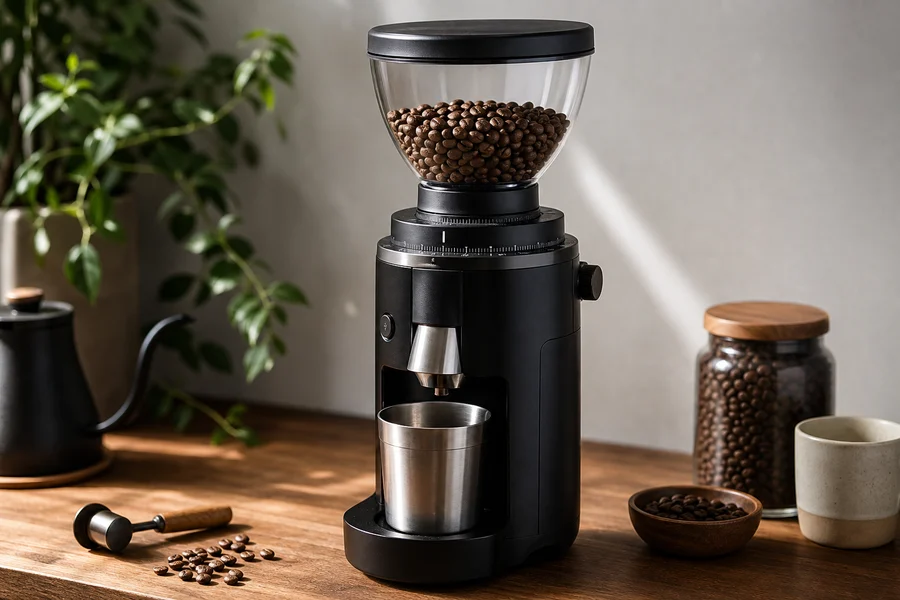
Why grinding decides the flavour
Grinding coffee right before brewing is, alongside water quality, the change that improves the cup the most. When you grind, you multiply the surface area exposed to oxygen and volatile aromas begin to evaporate within minutes: that's why pre-ground coffee loses its character so fast. But grinding isn't enough on its own: you need a uniform grind. If particle sizes vary widely, water extracts unevenly and the cup ends up both bitter (over-extracted fines) and sour (under-extracted boulders). That's the job of a good burr grinder.
The first thing to know
Burrs vs. blades
Blade grinders: spin at high speed chopping the bean at random. They produce dust and chunks at once, heat the coffee through friction and can't adjust size precisely. They're cheap, but they make consistent coffee impossible. Avoid them.
Burr grinders: crush the bean between two pieces at an adjustable distance, producing particles of uniform size. It's the only way to get a repeatable grind and to dial it to the method (fine espresso, medium filter, coarse press). Every grinder we recommend is a burr grinder.
Conical vs. flat burrs
Conical: a slightly bimodal grind that adds body and sweetness. Efficient and common in manual and home grinders. Great for traditional espresso.
Flat: a more unimodal (uniform) grind that gives clarity and flavour separation, valued in modern filter. To start out, burr quality and alignment matter more than shape.
The big decision
Manual vs. electric: which is for you?
At the same price, manual offers better burrs and less retention; electric wins on convenience and speed.
| Factor | Manual grinder | Electric grinder |
|---|---|---|
| Burr quality per euro | Very high (no motor cost) | Lower at the same price |
| Convenience and speed | 30-60 s of hand grinding | Instant, ideal for several cups |
| Coffee retention | Near zero (always fresh) | Low to medium by model |
| Portability and noise | Excellent, silent (travel) | Fixed and noisy |
| Best for | 1-2 cups/day, tight budget, travel | Several cups/day, convenience, family |
→ Decision guide: manual vs. electric grinder
Selection
Recommended manual grinders
High-end burrs and zero retention; the best value if you brew a few cups.
KINGrinder P2
Budget manual grinder for moka pot, French press, drip and occasional espresso.
- Analysis
- Steel conical burrs and external adjustment. Great value entry point; a little flex at very fine espresso settings.
KINGrinder K6
Advanced manual grinder for V60, Chemex, AeroPress, French press and espresso.
- Analysis
- External numbered dial with fine espresso steps and strong burrs. Versatile from filter to espresso.
TIMEMORE C3 ESP Pro
Mid-range manual grinder with high-precision steps, ideal for entry espresso and pour-over.
- Analysis
- Spring-loaded axle and stepped adjustment for repeatable, fine grinds. Excellent build for the price.
Comandante C40 MK4 Nitro Blade
Reference manual grinder for pour-over, filter and high-end espresso.
- Analysis
- Nitro-coated steel burrs, superb consistency and build quality. The benchmark many others are compared against.
1Zpresso J-Ultra
High-precision manual grinder designed specifically for dialing in espresso.
- Analysis
- Titanium-coated conical burrs with ~8μ micro steps and near-zero retention. Espresso-grade control by hand.
Selection
Recommended electric grinders
Convenience and speed for daily use; essential if you brew several cups or back-to-back shots.
Graef CM 702
Entry electric burr grinder for filter, French press and everyday use.
- Analysis
- Stainless conical burrs, 250 g hopper and stepped adjustment. Not the first pick for demanding espresso.
Graef CM 800
Sturdier electric home grinder to step up from the entry tier.
- Analysis
- Aluminium body, conical burrs and better build than the CM 702.
Fellow Ode Gen 2
Single-dosing flat-burr electric grinder optimised for filter coffee.
- Analysis
- 64 mm flat burrs, low retention and quiet operation. Outstanding clarity for pour-over; not aimed at espresso.
DieffematicKF molinillo eléctrico
Affordable electric burr grinder for everyday filter coffee.
- Analysis
- Adjustable burr settings for general home use at a low price.
Baratza Sette 270
High-speed electric grinder with near-zero retention and macro/micro adjustment.
- Analysis
- Conical burrs and true single-dosing with very fast grinding. Excellent for espresso workflows.
Eureka Mignon Facile
Compact flat-burr electric grinder with continuous micrometric adjustment.
- Analysis
- 50 mm flat burrs, stepless dialing and quiet operation. Great flavour clarity and durability.
Sage the Dose Control Pro
Versatile mid-range electric burr grinder with electronic timer for espresso and filter.
- Analysis
- Stainless conical burrs, 60 grind settings and a 1-second-step electronic timer.
Wilfa Svart Aroma
Molinillo eléctrico nórdico pensado para café de filtro, con temporizador.
- Analysis
- Muelas cónicas y molienda a baja velocidad (genera menos calor); depósito con protección UV. Limpieza sencilla y retención baja. Muy orientado a filtro (V60, Chemex, prensa francesa); no es la opción para espresso.
Baratza Encore
Molinillo eléctrico polivalente de referencia para filtro y uso diario.
- Analysis
- Muelas cónicas de acero de 40 mm con 40 niveles de molienda. Limpieza fácil (muela superior extraíble) y retención baja-media. El clásico de entrada para filtro, con repuestos y servicio técnico que alargan su vida.
FAQ
Frequently asked questions about grinders
Why shouldn't I buy a blade grinder?
Blade grinders chop beans at random at high speed, producing both very fine dust and large chunks at once. That uneven mix makes even extraction impossible: some compounds over-extract (bitterness) while others under-extract (sour acidity) in the same cup. The friction also heats the coffee and degrades aroma. A burr grinder (conical or flat) crushes the bean to a uniform size, which is the foundation of any good coffee.
Manual or electric: which one suits me?
At the same price, a manual grinder offers higher-quality burrs and near-zero retention because it doesn't pay for a motor. It's ideal if you brew 1-2 cups a day, value portability and don't mind grinding for 30-60 seconds. Electric wins on convenience and speed: essential if you brew for several people or several times a day, in exchange for a higher price and sometimes a bit more retention.
Conical or flat burrs?
Conical burrs tend toward a bimodal grind that adds body and sweetness, prized in traditional espresso and common in home and manual grinders for their efficiency. Flat burrs aim for a more unimodal (uniform) grind that gives clarity and flavour separation, valued in modern filter. To start out, burr quality and alignment matter more than shape.
Why does pre-ground coffee lose flavour so fast?
When you grind, the surface area exposed to oxygen multiplies, and volatile aromas start to evaporate and oxidise within minutes. Pre-ground coffee loses much of its aroma in 15-30 minutes and turns dull within days. Grinding right before brewing is, alongside water, the single change that improves the daily cup the most.
How much should I spend on the grinder vs. the machine?
The grinder is as important as the machine, if not more. A great machine with a mediocre grinder gives mediocre results, because grind consistency defines extraction. If your budget is tight, split it evenly and prioritise a decent burr grinder over an expensive machine paired with a poor grinder.
Next step
Pick the perfect grinder for your method
Espresso or filter? Dive into our comparisons to find the ideal grinder for your machine and budget.