Guide + Chart / Grinding / By method
What Grind Size to Use by Brew Method
Grind size is the master variable: it controls extraction speed and, with it, whether your coffee comes out balanced, sour or bitter. Here's a reference chart by method (with microns and texture) plus starting clicks. To understand the gear, head to the complete grinder guide.
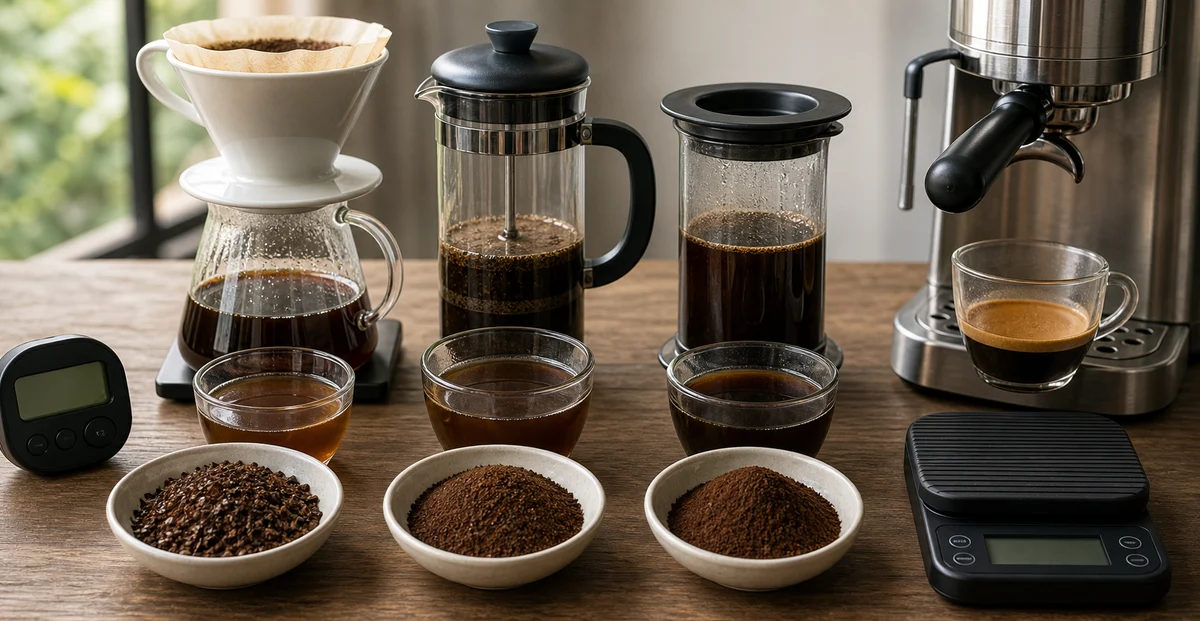
The principle: grind = extraction speed
The finer the grind, the more coffee surface exposed to water and the more resistance to flow, so water extracts faster. The coarser, the slower. The practical rule is simple: for fast, pressurised methods (like espresso), grind fine; for long immersion methods (like the French press or cold brew), grind coarse. How uniform that grind is depends on your burrs: read why in conical vs. flat burrs.
Grind chart by method
An indicative starting point. Every coffee and grinder differs: brew and adjust.
| Method | Grind | Approx. microns | Similar texture | Typical time |
|---|---|---|---|---|
| Espresso | Extra fine | 200-300 µm | Powdered sugar / fine flour | 25-30 s |
| Moka pot | Fine | 300-400 µm | Fine salt | 3-5 min |
| AeroPress | Fine-medium | 300-500 µm | Between fine and table salt | 1-2 min |
| V60 / pour-over | Medium-fine | 400-600 µm | Table salt | 2:30-3:30 |
| Chemex | Medium-coarse | 600-800 µm | Coarse salt | 4-5 min |
| French press | Coarse | 800-1100 µm | Sea salt / breadcrumbs | 4 min |
| Cold brew | Extra coarse | 1000-1200 µm | Coarse breadcrumbs | 12-18 h |
Starting clicks on popular grinders
From the closed position. Important: clicks vary between units and with wear; treat them as a starting point and dial to taste.
| Method | Comandante C40 (clicks) | Baratza Encore (1-40) |
|---|---|---|
| Espresso | 10-15 | 5-10 |
| Moka | 14-18 | 8-12 |
| AeroPress | 15-20 | 10-15 |
| V60 | 18-24 | 15-20 |
| Chemex | 24-28 | 20-25 |
| French press | 28-32 | 28-32 |
| Cold brew | 32-40 | 33-40 |
No grinder yet, or unsure which? Compare options in our guides to the best home grinders and espresso grinders, or decide between manual and electric.
How to dial
Adjust by taste, not by number
The chart gets you close; your palate gets you there. If the cup is sour, salty or watery, it's under-extraction: grind finer (or raise temperature/time). If it's bitter, dry or harsh, it's over-extraction: grind coarser (or shorten the time).
Change one variable at a time and taste. For espresso, where one click matters a lot, see our extraction troubleshooting guide.
Quick rule
Sour / watery → grind finer.
Bitter / dry → grind coarser.
And always: grind fresh, right before brewing.
Quick notes by method
Espresso
Extra fine and very precise: one click decides between 20 and 35 seconds of extraction. Needs a grinder with fine adjustment.
V60 and pour-over
Medium-fine (table salt). If water drains too fast, go finer; if it stalls, open up the grind.
French press
Coarse and uniform to avoid mud in the cup. The fewer fines, the cleaner it tastes.
Moka
Fine, but a touch coarser than espresso, so it doesn't clog or turn bitter. Don't tamp.
AeroPress
Very versatile: from fine (espresso style) to medium depending on the recipe and steep time.
Cold brew
Extra coarse: 12-18 h of cold immersion call for the coarsest grind to avoid bitterness.
FAQ
Frequently asked questions
Why does grind size change the flavour so much?
Because it controls extraction speed. The finer you grind, the more coffee surface you expose to water and the more resistance to flow, so water extracts faster. A grind too fine for the method over-extracts (bitterness); too coarse under-extracts (sour and watery). That's why each method has its ideal range.
Are the microns and clicks exact?
No, they're indicative. Microns depend on each coffee and burr, and clicks vary between units of the same grinder, with wear and with where 'zero' is set. Use them as a starting point and adjust to taste: brew, correct, repeat.
My V60 tastes sour and watery. What do I do?
Sounds like under-extraction: grind finer, raise water temperature a bit, or extend contact time. If instead it's bitter and dry, that's over-extraction: grind coarser or shorten the time. Change one variable at a time. For espresso, see our dedicated extraction troubleshooting guide.
Do I need an expensive grinder to nail the grind?
Not expensive, but a burr grinder. A blade grinder can't adjust size or grind uniformly, so no chart will help with one. With a decent burr grinder (manual or electric) you can move across all these ranges consistently.
Keep going deeper
Pick the grinder that lets you dial to taste
Fundamentals, manual vs electric and comparisons in the complete grinder guide.