Tools / Coffee Grinders / Filter Coffee
Best Coffee Grinders for Pour-Over, V60 & AeroPress: 2026 Guide
You’ve selected an exquisite single-origin coffee from Kenya or Ethiopia boasting delicate jasmine, lime, and peach tasting notes, yet your home brew finishes astringent, dry, or with a hollow bitter ashiness. In 90% of cases, the brewing dripper isn't to blame—the grinder is: sub-optimal burrs generate a massive cloud of microscopic dust (fines) that coats the filter paper, stalls drainage, and over-extracts bitter compounds.
Unlike espresso—where fines are vital to build resistance against 9 bars of pump pressure—in gravity-fed filter coffee, fines are your number-one adversary. Unlocking crystal-clear aromatics, lively acidity, and natural sweetness demands a clean, unimodal particle distribution. In this guide, we review and benchmark the 6 best manual and electric coffee grinders for V60, AeroPress, Chemex, and automatic batch brewers.
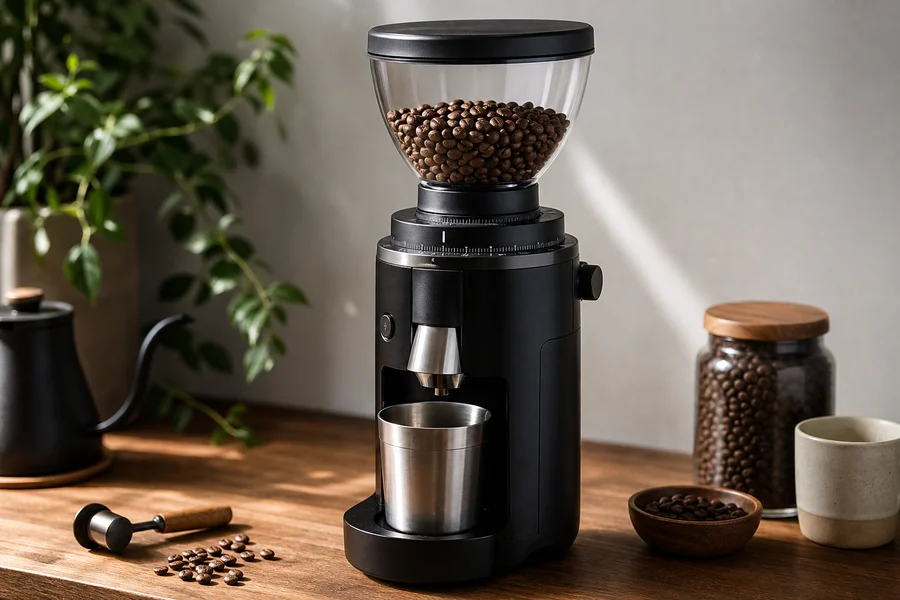
In 30 Seconds: Which Grinder Fits Your Morning Routine?
The ideal grinder depends on your daily brewing volume, whether you need lightweight travel portability, or if you demand surgical flavor clarity in the cup:
1Zpresso Q2 (Heptagonal)
Engineered with a 46 mm outer diameter that slides directly inside the AeroPress plunger. 38 mm heptagonal burrs with remarkably low fines production.
TIMEMORE C3 ESP Pro
Solid aluminum body with Spike-to-Cut (S2C 660) steel burrs and a foldable handle. The most affordable way to escape inconsistent ceramic hand mills.
Wilfa Svart Aroma
Slow-RPM DC motor minimizing frictional heat, UV-protected bean hopper, and intuitive settings for filter and AeroPress. A staple of Scandinavian kitchens.
Baratza Encore
The legendary workhorse of home filter brewing for over a decade. 40 mm conical burrs, 40 macro steps, and unparalleled manufacturer spare-parts availability.
Comandante C40 MK4
The gold standard in World Brewers Cup competitions. High-nitrogen martensitic Nitro Blade burrs offering unmatched grind uniformity and sensory precision.
Fellow Ode Gen 2
Engineered exclusively for filter coffee with 64 mm flat burrs, integrated plasma antistatic ionizer that eliminates mess, and auto-stop hopper shutoff.
Fluid Dynamics & Particle Physics
The Physics of Filter Grinding: The War on Fines
To understand why light-roast pour-overs turn bitter and chalky, we must examine the interplay of water flow, gravity, and ground coffee particle geometry:
The Fines Trap
Grinding coffee inevitably generates two distinct particle categories: the core coffee granules that form a permeable brewing bed and microscopic fines (dust particles under 100 microns). While boulders and medium grounds allow water to flow freely between them, fines detach and suspend in turbulent brew water.
Pulled down by gravity and hydraulic draw, these fines migrate toward the bottom of the cone and wedge themselves into the microscopic pores of the filter paper. The result is total hydrodynamic stalling (clogging or choking).
Channeling & Astringency
When the filter pores become sealed by a muddy fines layer, draw-down time escalates dramatically: a V60 brew calibrated for 3:00 minutes drags out past 4:30 or 5:00 minutes.
Unable to exit uniformly, water seeks paths of least resistance and cuts fissures into the coffee bed (channeling). Near-boiling water rushes through these cracks, severely over-extracting bitter polyphenols and astringent tannins that leave a dry, sandpaper sensation on the tongue.
Unimodal vs. Bimodal Burrs
Espresso grinders produce a distinctly bimodal distribution curve (two pronounced peaks: fine grounds and abundant microfines to restrict 9-bar water flow). Using that profile for pour-over guarantees muddy stalls.
In contrast, purpose-built filter grinders strive for a unimodal distribution (one tight, tall particle peak). By curbing fines, water flows evenly through the entire bed, illuminating juicy fruit acids and delicate floral notes in specialty roasts. Read more in our guide to conical vs flat burrs.
Side-by-Side Specifications
Comparison Matrix: The 6 Best Filter Grinders Side by Side
We compare burr architecture, fines control, static retention, and approximate pricing across every model:
| Model | Type | Burrs & Geometry | Fines Control | Static & Retention | Optimal Brewing Methods | Approx. Price |
|---|---|---|---|---|---|---|
| Fellow Ode Gen 2 Premium electric filter specialist | Electric | 64 mm stainless steel flat burrs Gen 2 | Minimal fines (exceptional clarity) | Plasma antistatic ionizer (<0.2 g retention) | V60, Chemex, Batch Brewer, Kalita Wave | ~399 € |
| Comandante C40 MK4 World-class manual reference | Manual | 39 mm conical Nitro Blade martensitic steel | Outstanding (cupping standard) | Borosilicate glass bean jar (zero retention) | V60, AeroPress, Cupping, Chemex | ~265 € |
| Baratza Encore Classic domestic workhorse | Electric | 40 mm conical M3 alloy steel | Low-to-Medium (consistent) | Medium (benefits from RDT technique) | Batch drip coffee, Daily V60, French press | ~169 € |
| Wilfa Svart Aroma Budget Scandinavian electric | Electric | Solid steel conical burrs with low-RPM motor | Low-to-Medium | Low-to-Medium (UV-protected hopper) | AeroPress, V60, Drip coffee maker, Chemex | ~119 € |
| 1Zpresso Q2 (Heptagonal) Ultra-compact travel hand grinder | Manual | 38 mm heptagonal (7-core) stainless steel | Very low (remarkable clarity) | Threaded aluminum catch cup | AeroPress (fits inside plunger), Portable V60 | ~109 € |
| TIMEMORE C3 ESP Pro Affordable versatile steel manual | Manual | 38 mm Spike-to-Cut (S2C 660) conical burrs | Low fines | CNC-machined aluminum body | V60, AeroPress, Occasional manual espresso | ~115 € |
Comprehensive Equipment Reviews
The 6 Best Filter Coffee Grinders Tested and Reviewed
We examine manufacturing build quality, ergonomics, grind particle consistency, and cost-to-performance ratio:
Fellow Ode Gen 2
- Burr Architecture
- 64 mm stainless steel flat Gen 2 burrs
- Hopper Capacity
- 100 g (designed for single dosing)
- Grind Settings
- 31 stepped settings via oversized front dial
- Key Technology
- Antistatic plasma ionizer & auto-stop motor
The Fellow Ode Gen 2 resolved the minor shortcomings of the original release: its re-profiled Gen 2 burrs cut with an aggressive new tooth geometry capable of reaching the fine threshold required for light Nordic V60 brews, while the built-in antistatic ionizer eradicates static cling, keeping your countertop free of flying chaff.
Equipped with horizontal 64 mm flat burrs, the Ode Gen 2 delivers an extraordinarily narrow particle distribution. It illuminates delicate floral aromatics and juicy acidity in light roasts that standard conical home grinders cannot replicate. Note that the Ode is strictly designed for brewed filter coffee and cannot grind fine enough for espresso.
Key Strengths
- Laboratory-grade flavor clarity and sparkling acidity.
- Plasma ionizer eliminates static chaff and mess entirely.
- Auto-stop sensor shuts off the motor right as the hopper empties.
- Standard 64 mm burr carrier compatible with aftermarket SSP burrs.
Trade-offs
- Premium price tag (~399 €).
- Incompatible with espresso (does not grind fine enough).
- Compact hopper intended purely for single dosing, not bulk storage.
Comandante C40 MK4 Nitro Blade
- Burr Material
- High-nitrogen martensitic Nitro Blade steel
- Capacity
- ~40 g of whole bean coffee
- Adjustment Mechanism
- Audible 3-arm star clicker under burrs
- Manufacturing
- Precision handcrafted in Munich, Germany
The Comandante C40 MK4 is the gold standard of specialty coffee. Global barista recipes are calibrated in «Comandante clicks» (typically 22 to 28 clicks for V60 pour-over). Its patented Nitro Blade burrs, machined from nitrogen-enriched martensitic steel, shear coffee beans rather than crushing them, suppressing uncontrolled fines shattering.
The MK4 upgrade overhauled the internal axle engine using high-density food-grade polymers that eliminate bean trapping in the loading chamber, while bundling two catch jars (one amber borosilicate glass and one lightweight unbreakable polymer jar for travel). With silky dual ball bearings, grinding a 15 g dose for V60 takes just 35 effortless seconds.
Key Strengths
- Legendary recipe repeatability recognized by baristas worldwide.
- Virtually indestructible burr steel that retains sharpness for decades.
- Exceptional balance of juicy acidity, sweetness, and velvety mouthfeel.
- Bundles both glass and travel-ready polymer catch jars.
Trade-offs
- Substantial investment for a manual grinder (~265 €).
- Internal click mechanism requires unscrewing the jar to adjust.
- Grinding large batches for multiple guests requires multiple cycles.
Baratza Encore
- Burrs
- 40 mm alloy steel conical M3 burrs
- Hopper Capacity
- 250 g whole bean hopper with safety shutoff
- Adjustment Range
- 40 macro settings by rotating the hopper
- Brand Ethos
- Modular repairability: Baratza stocks all replacement parts
The Baratza Encore is the undisputed classic entry grinder. It doesn’t try to win design awards or match the zero-static tech of the Fellow Ode, but it holds a massive advantage: true modular longevity. If an adjustment ring or gearbox wears out after five years, you can order official replacement parts for under 15 € and replace them yourself in 15 minutes.
In the cup, the Encore provides dependable particle consistency across V60, Chemex, and automatic drip brewers (settings 12 to 18). While the plastic grounds bin can develop static cling during dry winters, applying a single droplet of moisture to whole beans (the RDT technique) solves the problem immediately.
Key Strengths
- Unrivaled long-term spare parts availability and factory repair support.
- Straightforward operation: on/off toggle and front pulse button.
- Spacious 250 g hopper handles large carafes and multiple servings.
- Exceptional durability-to-price ratio.
Trade-offs
- Relatively loud motor noise during grinding.
- Plastic catch bin attracts static without RDT droplet prep.
- Generates more fines than the Fellow Ode's flat burrs.
Wilfa Svart Aroma
- Burrs
- Solid steel conical burrs with geared DC reduction motor
- Bean Hopper
- 250 g hopper with UV-protective tint
- Intuitive Dial
- Clear method zones: Moka, Aeropress, Filter, French Press
- Timer Feature
- Analog dial on the base for repeatable timed dosing
Co-developed in Norway in partnership with World Barista Champion Tim Wendelboe, the Wilfa Svart Aroma (CGWS-130B) upgrades the original Svart with an improved low-RPM DC motor. This restrained speed prevents frictional heat build-up during grinding, protecting delicate volatile flavor compounds.
Its user interface is exceptionally beginner-friendly: rather than arbitrary numbers, the hopper collar directly labels optimal zones for AeroPress, Filter, and French Press. Within the ~119 € price category, it delivers the most balanced fines profile of any European electric grinder.
Key Strengths
- Outstanding value for money (~119 €).
- Low-RPM motor reduces thermal friction and runs quieter than the Encore.
- Tinted hopper shields beans from ambient light exposure.
- Built-in timer allows hands-free dosing.
Trade-offs
- Plastic catch container is prone to static cling without RDT.
- Cannot grind fine enough for unpressurized commercial espresso baskets.
- Less widespread aftermarket spare parts compared to Baratza.
1Zpresso Q2 (Heptagonal)
- Burrs
- 38 mm 7-core heptagonal conical burrs in SUS420 steel
- Outer Diameter
- 46 mm (slides seamlessly into the AeroPress plunger)
- Capacity
- 15–20 g whole bean coffee
- Weight
- Just 465 g in CNC-machined anodized aluminum
The 1Zpresso Q2 (Heptagonal version) is one of the best-kept secrets in specialty coffee. While older pentagonal versions produced higher fines, the 7-sided heptagonal burr profile shears coffee beans with a cutting behavior remarkably close to Comandante's Nitro Blade, ensuring rapid, mud-free drainage in V60.
Its ergonomic stroke of genius is the 46 mm barrel diameter: it nests inside the hollow body of the AeroPress original plunger, transforming your coffee setup into a compact travel kit no larger than a water flask. For travelers and solo pour-over brewers, it delivers unbeatable clarity per euro.
Key Strengths
- Fits inside the AeroPress plunger for the ultimate portable travel setup.
- Heptagonal burrs deliver exceptional flavor separation for the price (~109 €).
- Solid aluminum body with knurled non-slip grip.
- Dual internal bearings prevent axle wobble.
Trade-offs
- Compact capacity (max 18-20 g of beans per grind cycle).
- Adjustment wheel located underneath the burrs.
- Not designed for grinding multi-cup batches.
TIMEMORE C3 ESP Pro
- Burr Design
- 38 mm Spike-to-Cut (S2C 660) conical burrs in SUS420 steel
- Crank Handle
- Patented spring-assisted fold-down crank handle
- Click Resolution
- High-precision 30 clicks per full dial revolution
- Capacity
- 20–25 g of coffee beans
The TIMEMORE Chestnut C3 ESP Pro refines the renowned C2/C3 hand grinder line with patented Spike-to-Cut (S2C 660) burrs. This two-stage geometry first fractures whole beans into uniform coarse granules at the burr crown before cleanly shearing them below, noticeably curbing random fines shattering.
The «ESP Pro» designation brings two significant advantages: double the click resolution on the adjustment dial for microscopic adjustments, and a folding crank handle that snaps flat against the body, making it effortless to slip into a backpack without unscrewing parts.
Key Strengths
- Clever fold-down crank handle saves significant drawer and bag space.
- S2C steel burrs vastly outperform entry-level ceramic mills.
- Fine click resolution provides nuanced grind calibration.
- Textured diamond-pattern metal body offers superior grip while grinding.
Trade-offs
- Produces slightly more fines on coarse settings than the 1Zpresso Q2 Heptagonal.
- 20-25 g capacity is tight if brewing carafes larger than 350 ml.
Advanced Barista Technique
Calibration Guide: How to Diagnose Your Grind in the Cup
Your brew timer and the visual appearance of the coffee bed after drawdown reveal exactly what happened during extraction:
Reading the Coffee Bed
As the final water stream drains through your pour-over cone, inspect the bed surface:
Flat and Sandy Bed: This is your target. Grounds resemble coarse sea salt or uniform wet sand with no surface sludge. It confirms a uniform grind with minimal fines migration.
Muddy Sludge and Pits: If the bed looks like melted chocolate or sticky paste with craters on the walls, your grinder produced a heavy cloud of fines that choked drainage. You need to upgrade burr alignment or dial in your grinder.
V60 vs. AeroPress Flow Demands
Different filter brewing methods have markedly different grind tolerances:
V60 (Pure Percolation): Extremely unforgiving. Relying entirely on gravity, any surplus of fines stalls the stream and ruins balance. Demands precision burr alignment (such as Ode, Comandante, or Q2).
AeroPress (Immersion + Pressure): Much more forgiving. Because brewing begins with full immersion and concludes with mechanical plunger pressure, fines won't choke your brew. Budget grinders like Wilfa or Timemore shine here. Read our complete AeroPress brew guide.
The RDT Trick Against Static Mess
Static electricity is the classic headache of electric grinders (especially Baratza and Wilfa): featherweight silver chaff flies outward and clings stubbornly to catch bins.
The cure is the Ross Droplet Technique (RDT): lightly moisten a teaspoon handle or fingertip with clean water and stir your whole coffee beans just before pouring them into the hopper. That microscopic moisture droplet (about 0.1% of bean weight) completely grounds electrostatic charge, letting ground coffee slide out effortlessly.
Common Questions
Frequently Asked Questions About Filter Coffee Grinders
Can I use an espresso grinder (such as Eureka Mignon) for V60 and pour-over?
Technically you can grind beans for filter with it, but cup results are almost always disappointing. Grinders engineered for espresso are intentionally designed to generate a bimodal particle distribution: a primary particle peak accompanied by a substantial volume of microscopic fines (<100 microns). Those fines are essential to create hydraulic resistance against a 9-bar pump in an espresso basket, but in gravity-driven pour-over like V60 or Chemex, they are disastrous: they migrate downward, choke the filter paper pores, push total brew time past 4 to 5 minutes, and produce harsh bitter astringency. Additionally, stepless micrometric dials make switching from fine espresso to coarse filter and back extremely tedious without losing your espresso calibration.
Why does my V60 take more than 4 minutes to draw down even when I grind coarser?
This is the well-known «fines paradox». When you grind coarser on an entry-level grinder or one with burr wobble, the coffee bean isn't sheared cleanly—it shatters and fractures, producing boulders accompanied by a massive cloud of microscopic dust. Because the bed particles are larger, interstitial voids are wider, allowing fines to easily detach during pour turbulence and settle straight onto the cone's paper tip, forming an impermeable seal. The solution is not grinding excessively coarse, but switching to a grinder with tighter burr alignment (unimodal distribution) and pouring with gentler agitation closer to the coffee bed.
Are flat burrs better than conical burrs for filter coffee?
It depends on your preferred sensory cup profile. Unimodal flat burrs (like the 64mm Gen 2 burrs in the Fellow Ode) produce an exceptionally narrow, uniform particle size spread: they cut fines to a minimum and deliver surgical floral and citrus flavor separation, transparency, and vibrant acidity—ideal for washed light roasts. High-end conical burrs (such as Comandante's Nitro Blade or 1Zpresso Q2's heptagonal set) offer a slightly wider particle spread that yields a silky body, rounded sweetness, and greater forgiveness with varied pouring techniques.
What is the difference between the standard Baratza Encore and the Encore ESP?
The classic Baratza Encore features 40 linear adjustment steps optimized specifically for filter brewing (V60, drip makers, Chemex, AeroPress, and French press), with each click shifting roughly 25 microns. The Encore ESP re-engineered the internal mechanism: steps 1 through 20 are micro-steps of ~20 microns dedicated to fine-tuning espresso, while steps 21 through 40 take much wider leaps for filter. If you exclusively brew pour-over and drip, the classic Encore offers far more granular, gradual control across medium and coarse ranges.
Is it really worth buying a coffee fines sifter (such as Kruve)?
For daily home brewing, it is rarely practical or cost-effective. A sifter like Kruve is an outstanding diagnostic and sensory calibration tool in coffee labs, but in a morning routine it creates substantial waste—often discarding 10% to 25% of your expensive specialty beans as sieved fines and boulders. You achieve vastly better daily value and sustainability by investing that budget directly into a grinder with superior burr geometry and tighter alignment (e.g., upgrading to a 1Zpresso Q2 or Fellow Ode).
Continue Elevating Your Filter Coffee
Grinding consistency is the first step toward a pristine cup. Explore our step-by-step brewing guides and recipes:
Step-by-Step V60 Recipe
Master Tetsu Kasuya's 4:6 pulse-pouring method to dial in dialed sweetness and vibrant acidity.
Grind Size Chart by Method
Visual micron benchmarks and step-by-step guidance for dialing in every brewing method.
Water Chemistry for Coffee
Why mineral balance, TDS, and chlorine filtration determine your coffee extraction quality.