Tools / Accessories / Espresso
Best Espresso Accessories for Home: 2026 Buyer's & Workflow Guide
Pulling an espresso at home is one of gastronomy's most unforgiving thermodynamic and hydraulic challenges: forcing water heated to 93 °C (200 °F) through a finely ground coffee puck under 9 bars of pressure (roughly 9 kg per square centimeter or 130 psi) in 25 to 30 seconds. At this immense pressure, water is merciless: any micro-fissure, uneven density pocket, or tilted surface becomes a path of least resistance, ruining your cup with severe channeling (channeling), biting acidity, and harsh dryness all at once.
In fact, 90% of defective shots in home espresso are not caused by the espresso machine, but by puck preparation flaws (puck prep). In this comprehensive guide, we dissect which accessories address real physical extraction mechanics in the cup, which are purely commercial gimmicks, and how to prioritize your investment step-by-step according to your machine's group diameter.
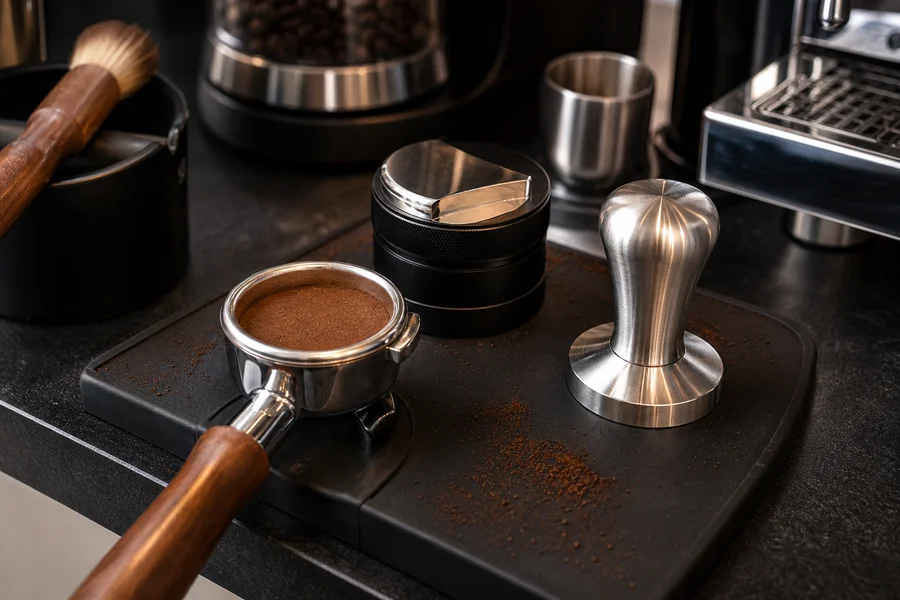
In 30 Seconds: The Espresso Accessory Priority Pyramid
You don't need to buy everything on day one. This impact hierarchy shows you exactly what gear to acquire at each stage of your home barista progression:
0.1 g Scale + WDT + Calibrated Tamper
The fundamental triad that prevents failure for 95% of home espresso beginners. Dial in your exact brew ratio in grams, disintegrate electrostatic grinder clumps, and lock in a 100% level 90° tamp with consistent 25–30 lb spring pressure.
Precision Basket + Puck Screen + Funnel
Unlocks maximum extraction yield and group cleanliness. Laser-perforated competition baskets (IMS/VST) allow ultra-fine grinding without clogging, contact puck screens soften water dispersion, and magnetic funnels keep your workflow mess-free.
Naked Portafilter + Barista Pitcher + Mat
Your real-time visual diagnostic window. A naked portafilter exposes micro-channeling and spurts instantly. A sharp-spout milk jug delivers control for pouring latte art, and a silicone corner mat protects your counter.
Investment Hierarchy
Priority Hierarchy Table: From Essential to Optional
Before spending on aesthetic upgrades, review the physical problem each tool solves and the exact benefit it delivers to your daily extraction:
| Accessory | Priority Tier | Approx. Price | In-Cup Impact | Why Buy It? |
|---|---|---|---|---|
| Digital scale with timer (0.1 g resolution) | 20 – 45 € | Maximum (Brew ratio control) | Allows stopping the extraction at your target liquid yield by weight (e.g., 18 g dose in → 36 g liquid out in 27 s) rather than relying on inconsistent crema volume. | |
| WDT tool (0.30–0.35 mm needles) | 12 – 25 € | Maximum (Anti-channeling) | Breaks up electrostatic clumps formed by grinder burrs and homogenizes particle density throughout the full depth of the basket before tamping. | |
| Calibrated self-leveling spring tamper | 25 – 48 € | Maximum (Level puck compression) | The outer collar rests flush on the basket rim, forcing a mathematically level 90° tamp. Eliminates sloped tamps responsible for 80% of peripheral channeling. | |
| Magnetic dosing funnel | Tier 2 (Very High) | 15 – 26 € | Indirect (Workflow & Dose Retention) | Allows deep, vigorous 3D WDT stirring without spilling coffee grounds over your countertop, ensuring your full measured dose stays in the basket. |
| Non-pressurized precision basket (IMS / VST) | Tier 2 (Very High) | 25 – 35 € | Very High (Sweetness & Clarity) | Laser-cut, micro-polished cylindrical holes eliminate irregular stamped burrs. Enables grinding significantly finer without choking the group, extracting higher TDS and sweetness. |
| Contact puck screen (150 µm / 1.7 mm) | Tier 2 (High) | 12 – 16 € | High (Gentle saturation & Cleanliness) | Cushions the violent mechanical blast of shower screen water, distributes saturation evenly, and stops coffee grounds from backing up into the brew group. |
| Bottomless portafilter (Naked) | Tier 3 (Medium-High) | 28 – 50 € | Visual Diagnostic | Exposes the basket underside during extraction to reveal channeling, dead zones, and pinhole spritzing immediately. Accommodates extra-deep competition baskets. |
| Barista milk pitcher (350–450 ml, sharp spout) | Tier 3 (Medium) | 14 – 25 € | High for milk drinks | Tapered ergonomic body rolls milk into a high-velocity vortex that pulverizes large bubbles into silky microfoam; sharp precision spout provides control for pouring latte art. |
| Silicone corner tamping mat | Tier 3 (Medium) | 12 – 18 € | Ergonomics & Safety | Anchors the portafilter firmly against countertop edges while applying 15 kg of tamping pressure, preventing slips, wrist strain, and furniture gouges. |
| Group cleaning detergent (Cafiza) + Blind disc + Brush | Tier 4 (Preventative) | 15 – 22 € | Sanitation & Pure Flavor | Chemically dissolves rancid, polymerized coffee oil buildup inside the shower screen and three-way solenoid valves that taints fresh beans with stale, ashy bitterness. |
Comprehensive Technical Breakdown
Tier-by-Tier Analysis: How Each Tool Works
The physics of high-pressure extraction explained tool-by-tool so you know exactly where your money goes.
Tier 1: The Three Non-Negotiable Essentials
1. Digital scale with integrated timer (0.1 g resolution)
Espresso is a recipe based on mass ratios, never liquid volume. When hot water traverses finely ground coffee, the volume of crema generated fluctuates wildly depending on bean roast date, origin, and varietal degassing. Evaluating an extraction by fluid ounce lines on a shot glass or by a machine's automated timer inevitably leads to overextracted (bitter, harsh, astringent) or underextracted (sour, salty, thin) cups.
A digital scale sensitive to one-tenth of a gram placed directly under your cup allows you to execute precise brew ratios (such as the specialty benchmark 1:2 ratio: 18 grams of dry ground dose yielding 36 grams of liquid beverage in 26 to 30 seconds) by cutting the pump on the exact second. Premium scales like the TIMEMORE Black Mirror feature real-time flow rate tracking and auto-tare timers that start on the first drop.
2. WDT tool with ultrafine needles (0.30–0.35 mm)
Grinding roasted coffee beans to the microscopic particle size required for espresso generates high friction and electrostatic charge, causing ground particles to coalesce into compact clumps. If you tamp coffee with internal clumps intact, those clusters act as impenetrable boulders: pressurized water simply diverts around them through adjoining low-density channels, severely overextracting fissures while leaving clump interiors completely dry.
The Weiss Distribution Technique (WDT) remedies this through ultrafine acupuncture needles (0.30 to 0.35 mm in diameter). By executing gentle, circular 3D stirring motions from the very bottom of the basket upward to the surface, you break every clump and homogenize particle density, ensuring pressurized water meets identical hydraulic resistance across every single square millimeter.
3. Calibrated self-leveling spring tamper
Manual tamping with a traditional unguided tamper demands flawless hand-eye coordination: a tilt of just 1 to 2 millimeters makes the coffee puck noticeably thinner on one side. Because 9-bar water strictly obeys fluid dynamics and seeks the path of least resistance, up to 80% of total water volume will rush through the lower half of the puck, overextracting it while leaving the elevated side untouched.
Modern self-leveling tampers (such as the Normcore V4 or NEOUZA calibrated ranges) feature a precision outer collar that registers flush against the basket rim. As you press downward, the base is physically forced into an exact 90° perpendicular plane, while an internal calibrated spring (15 to 30 lbs / 7–14 kg) guarantees perfectly repeatable compression shot after shot, regardless of operator fatigue.
Tier 2: The Quality Leap (Extraction Yield & Consistency)
1. Magnetic Dosing Funnel
A standard 18 g dose of freshly ground espresso coffee forms a fluffy, aerated mound that towers well above the basket rim prior to tamping. Attempting to execute WDT declumping without a funnel inevitably spills 1 to 2 grams onto your countertop, throwing off your carefully weighed ratio and creating annoying mess.
A precision metal funnel equipped with recessed neodymium magnets locks firmly onto the perimeter of 51, 54, or 58 mm portafilters. It serves as a protective containment wall, granting you freedom to stir aggressively through the entire depth of the basket without spilling a single grain of coffee.
2. Non-pressurized Precision Baskets (IMS / VST)
The perforated metal filter basket is the ultimate hydraulic barrier where extraction resistance is generated. In budget OEM factory baskets, holes are punched out by simple mechanical stamping: they feature conical edges, micro-burrs, and irregular apertures where coffee fines easily wedge and choke water flow.
Italian competition baskets such as IMS Precision (B70 series for 58 mm or B62.5 for Sage 54 mm) and VST utilize laser micro-machining with micrometer tolerances and polished cylindrical apertures. Eliminating random hole blockages reduces unpredictable backpressure, allowing you to grind substantially finer. This increases total dissolved solids (TDS), highlighting sparkling florals, ripe fruit acidity, and sweet caramel notes in specialty roasts.
3. Contact Puck Screen (1.7 mm and 150 µm)
Under high pump pressure, water bursts from machine shower screens through one or four narrow jet openings with high mechanical velocity. This focused stream tends to drill craters directly into the center of the coffee bed before full saturation can occur.
Placing a multi-layer sintered 150-micron stainless steel mesh screen over the tamped puck gently decelerates incoming water, spreading it evenly across the entire surface. Furthermore, once extraction concludes and the 3-way solenoid valve releases pressure, the puck screen stops wet grounds from being sucked up into the grouphead, keeping your shower screen spotless with just a dry towel wipe.
Tiers 3 & 4: Advanced Diagnostics, Ergonomics, and Preventative Maintenance
Bottomless Portafilter (Naked / Bottomless) • Tier 3
A standard spouted portafilter conceals the bottom of your filter basket beneath a metal floor and dual spouts. If violent channeling or dry pockets develop inside the puck, liquid converges inside the spouts and emerges looking misleadingly smooth, completely blinding the home barista.
A bottomless portafilter leaves the entire basket underside exposed, functioning as an invaluable live diagnostic camera. If your puck prep is flawed, you will observe erratic spraying (spritzing), slow spots, or uneven flow. If your WDT distribution and tamping are dialled in, streams coalesce gracefully into a centered golden column of silky crema. For deep diagnostics, see our espresso troubleshooting and extraction guide.
Barista Milk Pitcher & Silicone Tamping Mat • Tier 3
For lovers of cappuccinos and flat whites, a 350 to 450 ml stainless steel pitcher with an ergonomic tapered body allows steam pressure to spin milk into a rapid vortex, breaking large bubbles into glossy, elastic microfoam. Its acute pour spout provides precise flow control for executing crisp latte art rosettas and hearts.
Meanwhile, a 90° silicone corner mat locks securely over countertop edges, providing a steady, cushioned resting place for portafilter lugs under 15 kg of tamping pressure, preventing dangerous slippage and saving delicate wood and stone finishes from gouges.
Chemical Group Cleaning: Cafiza, Blind Disc & Brush • Tier 4
Natural coffee oils are packed with fatty acids that oxidize rapidly under the constant high heat of an espresso machine boiler. Over time, they polymerize into a dark, gummy, bitter residue coating your shower screen and internal solenoid valves. Without regular chemical backflushing, even a fresh €15 specialty coffee bag will taste astringent, rancid, and smoky.
An angled group brush scrubs the perimeter rubber gasket; a solid blind filter basket facilitates backflushing cycles; and a professional bio-soluble detergent like Urnex Cafiza dissolves stubborn coffee lipids without degrading chrome, brass, or stainless steel components.
Home Barista Mythbusting
The Trap of Useless Accessories: Not Everything Shiny Makes Better Coffee
Social media coffee trends have popularized flashy gadgets that promise café-quality shots but are actively debunked by extraction physics.
⚠️ The Mirage of Spin Wedge Distributors (Palm Levelers / Helix Distributors)
Palm levelers with rotating helical wedges are perennial bestsellers on Amazon due to their hefty, satisfying metal feel. However, their mechanism is a deceptive optical illusion:
- Deceptive surface compression: As the blades spin over loose grounds, they only compress the top 2 millimeters of coffee, burnishing them into a mirror-smooth surface.
- Untouched voids and clumps: Below those top 2 mm, internal air pockets, uneven density distribution, and grinder clumps remain completely untouched.
- Detrimental density gradient: By forming a dense hard crust over a loose, clumped base, incoming 9-bar water shears sideways, causing severe internal channeling that degrades shot balance.
💡 Technical Verdict: Save the €20–€30 on blade levelers. A €12 fine-needle WDT tool provides 10 times more effective, true volumetric distribution across the entire puck.
⚠️ The Disaster of Stock Plastic Tampers
Nearly every entry-level espresso machine (such as De'Longhi Dedica, Stilosa, or Krups) includes a cheap black plastic measuring spoon with a flat "tamper" base. Using it guarantees poor extractions for three physical reasons:
- Undersized diameter and peripheral gaps: They typically measure 49 or 50 mm for a 51 mm basket, or 52 mm for a 54 mm basket. They leave an uncompressed border over 1 mm wide, causing donut channeling.
- Convex flexing base: Flexible plastic bows under hand pressure, preventing you from applying more than 3 or 4 kg of force and leaving the puck soft and spongy.
- Unavoidable sloping: With zero counterweight or inertial mass, holding the tamper perpendicular to the basket is nearly impossible.
💡 Technical Verdict: Discard the plastic tamper on day one. A solid stainless steel calibrated tamper sized to your basket's exact millimeter specification is the single best investment to stabilize your espresso.
Mechanical Tolerances
Critical Sizing & Compatibility Rulebook: 51 mm, 54 mm, and 58 mm
The number-one mistake when ordering espresso accessories is trusting the "nominal diameter". Check these exact measurements before placing an order:
| Nominal Diameter | Representative Machines | Exact Tamper Size | Optimal Puck Screen | Critical Advice |
|---|---|---|---|---|
| 51 mm | De'Longhi Dedica (EC680/EC685), De'Longhi Stilosa (EC260), Krups Virtuoso+, Smeg ECF01 | 51.0 to 51.35 mm | 51.0 mm (0.8 mm or 1.7 mm) | 51 mm baskets are tall and narrow. For open unpressurized baskets, always choose a 51.35 mm base to eliminate side-wall donut gaps. |
| 54 mm | Sage / Breville The Bambino / Bambino Plus, Barista Express, Barista Pro, Barista Touch | 53.3 to 53.4 mm (Never 54.0 mm!) | 53.5 mm (1.7 mm) | Sage basket walls taper slightly inward toward the bottom. A true 54.0 mm tamper scrapes metal and gets suction-locked. The exact precision fit is 53.3 mm. |
| 58 mm | Commercial E61 groups (Rocket, Lelit MaraX/Bianca, ECM, Profitec), Gaggia Classic, Ascaso Steel | 58.4 to 58.55 mm | 58.5 mm (1.7 mm) | Nominal 58 mm tampers leave a 0.7 mm peripheral gap inside precision IMS/VST baskets. Always demand a 58.5 mm base to tamp the entire edge. |
🔗 Need to verify the locking lugs and bayonet ears of your specific model?
If you are unsure whether your portafilter has 2 or 3 locking ears or how deep your group head is, read our full Espresso Accessories Compatibility Guide. And if you have yet to purchase a machine, check out our comparison of the best espresso machines for beginners.
Verified Selection
Café Guru Recommended Accessories Catalog
We examine technical specifications, build materials, pros, cons, and current pricing to equip your home coffee station.
TIMEMORE Black Mirror Basic 2 Scale
- Category
- Digital Scale & Timer
- Compatibility
- Universal (espresso & pour-over)
- Materials
- Matte acrylic with silicone insulating pad
- Key Highlight
- 0.1 g fast response, auto-timer mode triggered by first drop, USB-C rechargeable battery, and compact footprint.
✓ Strengths (Pros)
- Rapid 0.1 g resolution with ultra-low latency as espresso drops hit the cup.
- Auto-timer mode triggers automatically upon sensing flow onset.
- Long-lasting USB-C rechargeable lithium battery.
✕ Caveats & Limitations (Cons)
- Tight squeeze on ultra-narrow drip trays (e.g. unmodified De'Longhi Dedica).
- Water-resistant against splashes, but cannot be submerged under running taps.
WDT Espresso Tool with 0.35 mm Needles
- Category
- WDT Declumping Tool
- Compatibility
- Universal (51, 54, 57, 58 mm)
- Materials
- 304 stainless steel needles + anodized aluminum body
- Key Highlight
- Ultrafine 0.35 mm stainless needles gently declump without plowing or compacting grounds across any basket diameter.
✓ Strengths (Pros)
- Ultrafine 0.35 mm needles break up clumps without displacing coffee mass.
- Includes a sturdy tabletop stand and replacement needles.
- Eliminates the root cause of channeling on high-clump grinders.
✕ Caveats & Limitations (Cons)
- 0.35 mm needles are flexible and can bend if mishandled or dropped.
- Requires pairing with a dosing funnel to prevent coffee grounds from spilling over.
Normcore V4 Spring-Loaded Tamper 58.5 mm
- Category
- Calibrated Tamper (58.5 mm)
- Compatibility
- 58 mm commercial groups (E61, Gaggia, Lelit)
- Materials
- 304 stainless steel base + aluminum alloy handle
- Key Highlight
- Exact 58.5 mm perimeter fit eliminates side clearance in IMS/VST baskets, preventing edge donut channeling. Includes 15, 25, and 30 lb springs.
✓ Strengths (Pros)
- Exact 58.5 mm diameter leaves zero peripheral play in IMS/VST precision baskets.
- Self-leveling collar forces a mathematically flat 90° horizontal puck face.
- Includes three interchangeable springs (15 lb, 25 lb, and 30 lb pressure).
✕ Caveats & Limitations (Cons)
- Higher initial cost compared to non-spring basic manual tampers.
- Not compatible with heavily tapered, non-standard 58 mm baskets.
Normcore V4 Tamper 53.3 mm for Sage / Breville
- Category
- Calibrated Tamper (53.3 mm)
- Compatibility
- Sage / Breville 54 mm (Bambino/Express/Pro)
- Materials
- 304 stainless steel base + aluminum alloy handle
- Key Highlight
- 53.3 mm diameter perfectly matches the slight taper of Sage OEM and IMS 54 mm baskets, preventing suction locking.
✓ Strengths (Pros)
- Exact 53.3 mm base matches the subtle conical taper of Sage baskets.
- Prevents the vacuum suction jamming caused by generic 54.0 mm tampers.
- Calibrated spring completely eliminates human variance and wrist fatigue.
✕ Caveats & Limitations (Cons)
- Exclusively fits 54 mm Sage machines; unusable if you upgrade to 58 mm.
- Must be dried thoroughly after cleaning to safeguard internal springs.
NEOUZA Calibrated Tamper 51 mm / 51.35 mm
- Category
- Calibrated Tamper (51.35 mm)
- Compatibility
- De'Longhi 51 mm (Dedica, Stilosa, Krups)
- Materials
- 304 stainless steel base + aluminum alloy handle
- Key Highlight
- Heavy-duty 51.35 mm flat stainless base with constant-pressure spring. Replaces flimsy stock plastic spoons with reliable level tamps.
✓ Strengths (Pros)
- 51.35 mm CNC-machined base seals edges tightly in De'Longhi Dedica baskets.
- Replaces the useless stock plastic scoop with substantial solid stainless steel.
- Excellent value for money to achieve consistent, repeatable extractions.
✕ Caveats & Limitations (Cons)
- Only compatible with 51 mm baskets (will not fit if upgrading to 54 or 58 mm).
- Does not include swappable springs like higher-tier models.
Normcore Magnetic Dosing Funnel (54 mm / 58 mm)
- Category
- Magnetic Dosing Funnel
- Compatibility
- 54 mm and 58 mm portafilters
- Materials
- Anodized aluminum with embedded neodymium magnets
- Key Highlight
- Embedded neodymium magnets lock firmly onto portafilter rims, enabling vigorous 3D declumping without countertop mess.
✓ Strengths (Pros)
- Embedded neodymium magnets provide a rock-solid, wobble-free hold.
- Allows aggressive 3D WDT stirring without losing a single speck of coffee.
- Low-profile design clears common grinder forks and chutes easily.
✕ Caveats & Limitations (Cons)
- Must be removed right before applying the final tamp.
- Ensure you select the exact diameter (54 mm vs 58 mm) matching your handle.
Puck Screen Contact Mesh (51 / 53.5 / 58.5 mm)
- Category
- Puck Screen (Contact Mesh)
- Compatibility
- Available in 51, 53.5, and 58.5 mm
- Materials
- 316 multi-layer sintered stainless steel mesh
- Key Highlight
- Available in exact diameters (51, 53.5, and 58.5 mm) at 1.7 mm thickness. Softens water impact and shields shower screens from grimy sludge.
✓ Strengths (Pros)
- 150-micron sintered mesh softens violent high-velocity water jets from the shower screen.
- Keeps the dispersion screen completely free of oily coffee slurry.
- Produces a drier, firmer puck that knocks out cleanly in a single tap.
✕ Caveats & Limitations (Cons)
- Consumes ~1.7 mm of basket headspace: may require dosing down by 0.5–1 g.
- Requires a quick hot water rinse after each shot to prevent coffee oil build-up.
IMS Competition Precision Basket 58 mm (18-20 g)
- Category
- Precision Basket (58 mm)
- Compatibility
- Commercial 58 mm E61 groupheads
- Materials
- Food-grade AISI 304 polished stainless steel
- Key Highlight
- Compatible with E61 groups, Gaggia Classic, Ascaso Steel, and standard 58 mm portafilters. Requires a 58.4–58.5 mm tamper.
✓ Strengths (Pros)
- Laser-perforated cylindrical holes manufactured to tight micrometer tolerances.
- Enables grinding significantly finer without choking, boosting in-cup extraction yield (TDS).
- Standard commercial compatibility with E61, Gaggia Classic, and Ascaso machines.
✕ Caveats & Limitations (Cons)
- Highly demanding on grind quality: will expose inconsistencies on cheap grinders.
- Strictly requires a calibrated 58.4 to 58.5 mm tamper for edge seal.
IMS Precision Nanotech Basket 54 mm Sage / Breville
- Category
- Precision Basket (54 mm)
- Compatibility
- Sage / Breville 54 mm groups
- Materials
- Food-grade AISI 304 polished stainless steel
- Key Highlight
- Reduces micro-channeling on Sage Bambino and Barista Express. Nanotech surface resists coffee oils and cleans instantly.
✓ Strengths (Pros)
- Non-stick Nanotech coating repels coffee oils and wipes clean effortlessly.
- Delivers significantly more uniform water flow on Sage Bambino and Express machines.
- Enhances flavor clarity and unlocks delicate floral and fruity notes in light roasts.
✕ Caveats & Limitations (Cons)
- Sensitive nanotech coating must not be cleaned with caustic chemicals or abrasive pads.
- Noticeably higher price tag than generic stamped single-wall baskets.
Davonpha Bottomless Portafilter 54 mm Sage / Breville
- Category
- Bottomless Portafilter (54 mm)
- Compatibility
- Sage Bambino, Pro, Express 54 mm
- Materials
- Cast stainless steel head + ergonomic natural hardwood handle
- Key Highlight
- Includes an 18 g unpressurized basket. Reveals channeling, spritzing, and uneven puck saturation instantly.
✓ Strengths (Pros)
- Essential real-time visual diagnostic tool to identify channeling on Sage machines.
- Ergonomic solid hardwood handle with balanced counterweight.
- Accommodates deeper, high-dose precision baskets (18–22 g) without bottom interference.
✕ Caveats & Limitations (Cons)
- Any puck prep flaw will spray coffee streams outside your cup.
- Hardwood handle must never be soaked or run through a dishwasher.
NEOUZA Bottomless Portafilter 51 mm De'Longhi Dedica
- Category
- Bottomless Portafilter (51 mm)
- Compatibility
- De'Longhi Dedica EC680/EC685/EC885
- Materials
- Cast stainless steel head + ergonomic natural hardwood handle
- Key Highlight
- Transforms budget De'Longhi machines into true open-basket espresso setups. Eliminates pressurized crema baffles.
✓ Strengths (Pros)
- Precision-machined 3-ear bayonet specifically designed for De'Longhi Dedica.
- Converts budget machines into true open barista stations with single-wall baskets.
- Yields genuine espresso extraction without artificial pressure-valve foam.
✕ Caveats & Limitations (Cons)
- Incompatible with 2-ear machines (Smeg, Cecotec) and 54/58 mm groupheads.
- Demands fresh whole bean coffee and an espresso-grade burr grinder.
Silicone Corner Tamping Mat for Espresso
- Category
- Silicone Tamping Mat
- Compatibility
- Universal with 90° countertop edge lip
- Materials
- Heavy-duty food-grade high-density silicone
- Key Highlight
- Heavy-duty food-safe silicone with a 90° overhang and tamper resting slot. Prevents surface scratches and slips under heavy pressure.
✓ Strengths (Pros)
- 90° overhang hugs countertop edges for rock-solid stability during high-pressure tamping.
- Heavy-duty food-grade silicone absorbs downward force without flexing or degrading.
- Integrated circular cradle keeps your tamper clean, protected, and within reach.
✕ Caveats & Limitations (Cons)
- Naturally attracts static coffee dust (rinses off easily under running water).
- Requires dedicated counter-edge real estate next to your machine.
Urnex Cafiza 2 Cleaning Powder 900 g
- Category
- Group Cleaning Detergent
- Compatibility
- Espresso machines with 3-way solenoid valve
- Materials
- Bio-soluble espresso group detergent powder (900 g)
- Key Highlight
- Dissolves rancid coffee lipids and stale residue. Essential for periodic chemical maintenance and clean flavor.
✓ Strengths (Pros)
- Commercial-strength formula rapidly breaks down polymerized rancid coffee oils.
- Economical 900 g jar lasts well over a year of regular backflushing.
- Essential for maintaining clear flavor and extending 3-way solenoid valve lifespan.
✕ Caveats & Limitations (Cons)
- Not applicable to machines lacking a 3-way solenoid valve (cannot be backflushed).
- Never use on aluminum parts (suitable for stainless steel and chrome-plated brass only).
Barista Ecosystem
How to Integrate Accessories into Your Coffee Station
Accessories optimize your extraction, but they belong to an integrated chain where every link matters:
☕ The Coffee Grinder
No accessory can rescue an inconsistent or coarse grind. If you are still using a blade grinder or pre-ground coffee, your first investment must be a proper espresso grinder.
⚙️ The Right Espresso Machine
If you are shopping for your first manual or semi-automatic machine, review our guide to the best espresso machines for beginners and our analysis of the best value espresso machine.
💰 Total Setup Budget
How much does it actually cost to build a real home espresso bar without hidden surprises? We break down full equipment and accessory budgets in our guide to home espresso setup costs.
📖 The Master Espresso Guide
Learn how to dial in brew temperature, pre-infusion, and grind distribution in our comprehensive manuals on the espresso brewing method and our espresso troubleshooting and extraction guide.
Common Inquiries
Frequently Asked Questions About Espresso Accessories
Direct, technical answers to the most common questions before investing in home barista tools.
Why is a WDT tool superior to a palm wedge distributor?
Rotating blade levelers or palm wedge distributors look sleek and leave the puck surface visually polished, but CT scans and refractometry confirm that they only compress the top 2 to 3 mm of grounds without breaking clumps or redistributing coffee deeper in the basket. This creates an uneven density gradient (an ultra-dense top crust over loose, clumped grounds below) that actually aggravates internal channeling. The Weiss Distribution Technique (WDT) using ultrafine 0.30–0.35 mm needles is the only method that mechanically declumps and homogenizes puck density throughout the entire depth of the basket.
Does a precision basket (IMS/VST) really improve coffee taste?
Yes, significantly—provided you have a capable espresso-focused burr grinder. Factory-stock baskets shipped with most home espresso machines are mechanically stamped, leaving irregular, conical holes with microscopic burrs that restrict water flow unevenly. In contrast, competition baskets (such as IMS Precision or VST) feature laser-cut, highly consistent cylindrical holes with tight micrometer tolerances across the entire surface. This allows you to dial in a noticeably finer grind size without clogging the filter, unlocking higher extraction yields (TDS), cleaner acidity, and amplified sweetness without astringency.
What size tamper do I need for my machine? (51.35 mm vs 53.3 mm vs 58.5 mm)
You must match your tamper to your basket's actual internal diameter rather than its nominal rating. For De'Longhi Dedica and 51 mm groups, unpressurized baskets require a 51.35 mm tamper to prevent outer perimeter donut channeling. For Sage / Breville 54 mm machines (Bambino, Barista Express, Pro), basket sidewalls taper slightly inward, so a 54.0 mm tamper will jam against the metal walls—the exact precision fit is 53.3 mm (or 53.4 mm). For commercial 58 mm groups (E61, Gaggia Classic, Lelit), standard 58.0 mm tampers leave a sloppy 0.7 mm gap; you should always use a 58.4 to 58.55 mm base.
Is a bottomless portafilter necessary for good espresso?
A bottomless (naked) portafilter doesn't magically improve extraction on its own, but it serves as an indispensable real-time diagnostic window into your puck preparation. Standard spouted portafilters mask catastrophic channeling, spraying, and dry spots because streams converge blindly before emerging from the spouts. With a bottomless portafilter, you instantly see whether your WDT and tamping created an even extraction or if pressurized water is jetting through fissures. It also accommodates taller, high-dose precision baskets (18–22 g) that physically cannot fit inside shallow stock spouted handles.
Next Step
Master Your Barista Technique
Dial in extraction variables and learn to fix channeling before upgrading your equipment.