Tools / Coffee Makers / Specialty Coffee
Best Coffee Makers for Specialty Coffee at Home
You've purchased a €14 bag of single-origin specialty coffee boasting tasting notes of jasmine, peach, and bergamot, but brewing it at home yields a cup that tastes sour, astringent, or disappointingly flat. Over 80% of specialty beans fail on cheap $25/€25 supermarket drip machines not because of user error, but due to insurmountable thermodynamic limitations: their low-power heating elements deliver water below 88°C (190°F) causing sour underextraction, their single-stream showerheads bore a hole through the center of the bed causing severe channeling, and their lack of thermal stability ruins any delicate aromatic profile.
To unlock the aromatic potential of beans graded 80+ SCA points, coffee physics demands three non-negotiable imperatives: stable brew water temperature between 92°C and 96°C (197°F–205°F), uniform shower dispersion across the entire coffee bed, and a controlled hydrodynamic contact time. In this guide, we compare the market's best coffee makers across every dynamic: manual pour-over cones for surgical clarity, SCA-certified automatic batch brewers for effortless consistency, and precision home espresso machines.
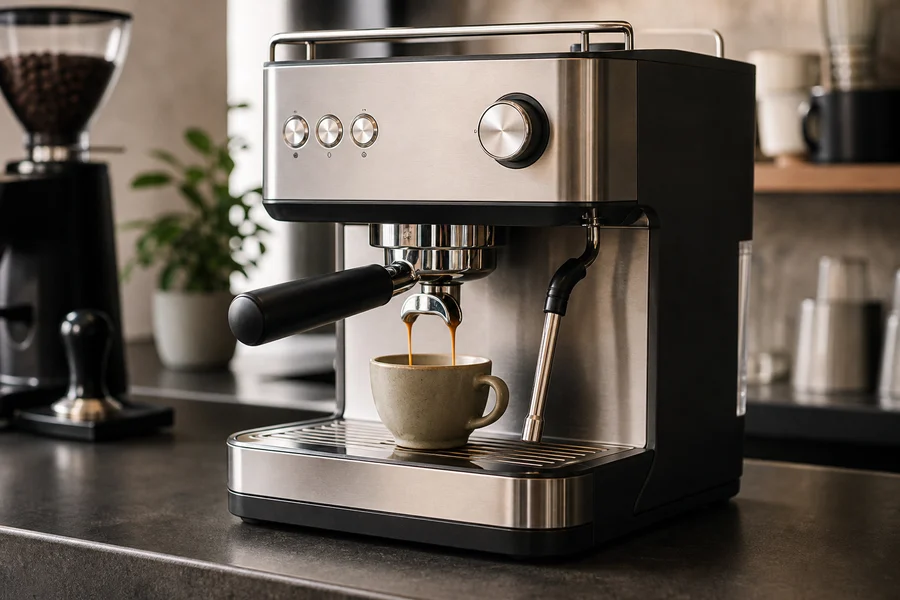
In 30 Seconds: Which Coffee Maker Fits Your Routine?
The best brewer is not the most expensive or the most complex, but the one that aligns with your morning workflow and flavor preferences:
Hario V60 (02 Plastic)
The global benchmark for highlighting light-roast washed coffees from Ethiopia or Kenya. Surgical clarity of floral and citric notes in exchange for a 4-minute mindful ritual with a gooseneck kettle.
AeroPress Original
Full immersion and gentle pneumatic pressure. Boosts sweetness and velvety body, forgives grind inconsistencies, and cleans up in just 10 seconds. Essential for travel, camping, and offices.
Moccamaster KBG Select
Gold Cup filter coffee at the press of a single button. Copper heating element reaching 94°C in seconds, hand-assembled in the Netherlands, and engineered to last decades.
Sage Precision Brewer
For enthusiasts who want programmable bloom times, degree-by-degree PID thermal control, and interchangeable flat-bottom or conical baskets. The most technologically advanced batch brewer.
Sage The Bambino Plus
True 9-bar extraction with OPV, 3-second ThermoJet heat-up, and an auto-purging steam wand that produces genuine silky microfoam for specialty flat whites and cortados.
Technical Comparison Matrix
Specialty Coffee Makers Head-to-Head Comparison
We analyze extraction hydrodynamics, daily time commitment, and total required setup investment across each brewing category:
| Extraction Dynamic | Representative Model | Cup Flavor Profile | Daily Time | Technical Difficulty | Estimated Investment (Brewer + Grinder) |
|---|---|---|---|---|---|
| Manual Percolation (Conical pour-over) | Hario V60 (02 Plastic) | Surgical aromatic clarity, light and tea-like body, sparkling malic acidity, and pronounced floral notes. | 4–6 min | Medium-High (pulse-pouring technique) | ~€80–130 (V60 ~€10 + Gooseneck kettle/Scale + Manual grinder) |
| Immersion + Pressure (Pneumatic plunger) | AeroPress Original | Rich fruit sweetness, medium silky body, balanced rounded acidity, and exceptionally low bitterness. | 2–3 min | Low (highly forgiving of grind errors) | ~€75–120 (AeroPress ~€36 + All-round hand grinder) |
| Slow Glass Drip (Thick bonded filter) | Chemex Classic (6-Cup) | Luminous and translucent cup, crystal clarity with zero fines or heavy oils; refined, tea-like elegance. | 5–7 min | Medium (flow rate control and medium-coarse grind) | ~€120–170 (Chemex ~€56 + Gooseneck kettle + Burr grinder) |
| SCA Automatic Batch Brewer (Certified batch brew) | Moccamaster KBG Select | Balanced sweetness, clean cup, unwavering repeatability from 2 to 10 cups at the touch of a button. | 5–6 min (hands-free) | Minimal (single switch operation) | ~€350–450 (Brewer ~€259 + Electric burr grinder) |
| Digital PID Automatic (Advanced digital extraction) | Sage Precision Brewer | Maximum versatility: switch between flat-bottom sweetness or conical acidity via digital recipes. | 5–8 min (hands-free) | Medium (menu navigation and profile setup) | ~€400–500 (Brewer ~€299 + Filter burr grinder) |
| Specialty Home Espresso (9-bar OPV + Microfoam) | Sage The Bambino Plus | Dense syrupy body, concentrated sweetness, persistent crema, and perfect base for flat whites and latte art. | 3–5 min | High (micrometric grind dial-in and puck prep) | ~€700–850 (Machine ~€529 + Dedicated espresso grinder) |
Block 1: Manual Filter Methods
Manual Filter: Mindful Ritual, Precise Control, and Peak Aromatic Nuance
Manual pour-over and gentle immersion remain the cornerstone of specialty coffee culture. Unencumbered by pumps or electronic heating circuits, these manual tools translate your technique directly into flavor: every adjustment in grind size, pour cadence, or bloom duration reflects immediately in the cup.
Hario V60 02 plástico
- Material
- BPA-free polypropylene (maximum thermal insulation)
- Geometry
- 60° cone with interior spiral ribs
- Capacity
- Size 02 (1 to 4 cups / up to 500 ml)
- Bottom aperture
- Large central opening (unrestricted flow rate)
- Required accessories
- Gooseneck kettle and precision timer scale
- Cleaning
- Instant rinse under tap; dishwasher-safe
The Hario V60 is the most decorated dripper in World Brewers Cup history. Its design represents meticulous fluid dynamics: an exact 60-degree cone angle that concentrates a deep coffee bed, curved interior spiral ribs that elevate the paper filter to allow unrestricted air release, and a large bottom aperture that leaves flow rate regulation entirely to your grind size and pour cadence.
Why is the plastic version superior to ceramic and glass? Common intuition suggests ceramic feels more premium. However, in pour-over thermodynamics, ceramic and glass possess high thermal mass and conductivity: they behave as heatsinks, sapping thermal energy from brew water and plummeting slurry temperatures from 94°C down to 85°C during the critical first 30 seconds unless preheated with half a liter of boiling water. BPA-free polypropylene is a natural thermal insulator with negligible heat absorption, preserving consistent slurry temperatures throughout extraction. Furthermore, it is shatterproof, weighs under 100 grams, and costs a fraction of alternative materials. Master the technique with our step-by-step V60 recipe or read our in-depth V60 brewing guide.
✓ Technical Strengths
- Unmatched aromatic clarity: cleanly separates delicate notes of jasmine, lime, and stone fruit.
- Thermodynamically superior and more stable than ceramic cones without requiring heavy preheating.
- Extremely affordable (under €15) and virtually indestructible polypropylene construction.
- Complete millimeter control over brew ratio, agitation turbulence, and percolation drawdown rate.
✕ Key Trade-Offs
- Steep learning curve: an erratic or inconsistent pour causes immediate channeling.
- Mandatory accessories required: a gooseneck kettle and precision timer scale are essential.
- Single-serve capacity: designed for 1 to 2 cups per brew cycle.
AeroPress Original
- Brewing mechanics
- Full immersion + Gentle plunger pressure (0.5–0.7 bar)
- Liquid capacity
- ~250 ml (1 generous mug or concentrate for 2)
- Total brew time
- 1 to 2 minutes total extraction
- Material
- Ultra-durable, food-grade BPA-free polypropylene
- Filters
- Circular paper microfilters (350 included)
- Cleaning
- Self-cleaning puck ejection into compost bin (10 s)
Invented in 2005 by Stanford engineer and inventor Alan Adler, the AeroPress Original transformed home brewing by addressing the fundamental flaw of the traditional French press: muddy silt and astringent overextraction. Its operation merges full immersion (saturating all coffee particles simultaneously with zero risk of preferential water channels) with gentle downward pneumatic pressure pushing the brew through a fine paper microfilter.
The result in the cup is a round, juicy coffee with mellow acidity and a velvety body completely free of suspended solids. Its brewing tolerance is extraordinary: it welcomes grinds from fine to medium-coarse without bitterness, and accommodates standard upright brewing as well as the renowned inverted method. Moreover, it is the quickest and cleanest brewer ever made: simply pop the filter cap off, push the plunger to eject the spent puck directly into the compost bin, and rinse the rubber seal. Explore every recipe variation in our AeroPress guide and master the method with our AeroPress recipe.
✓ Technical Strengths
- Extreme brewing forgiveness: virtually impossible to ruin a cup even with an imperfect grind.
- Lightning-fast 10-second cleanup without coffee grounds clogging the kitchen sink.
- Indestructible, lightweight build: the undisputed favorite for travel, camping, and office desks.
- Huge global community with thousands of championship-winning recipes to explore.
✕ Key Trade-Offs
- Single-serve capacity: limited to ~220–250 ml of brewed coffee per press.
- Slightly less analytical separation of faint floral high notes compared to a conical V60.
- Utilitarian syringe aesthetic that may not suit formal table settings.
Chemex Classic 6 tazas
- Material
- Non-porous borosilicate glass with wooden collar and leather tie
- Capacity
- 900 ml (classic 6-cup model)
- Filter type
- Special Chemex bonded triple-layer filters (20–30% thicker)
- Required grind
- Medium-coarse uniform grind with minimal fines
- Brew time
- 4 to 5 minutes
- Design icon
- Permanent collection at the Museum of Modern Art (MoMA) NYC
Designed in 1941 by chemist Dr. Peter Schlumbohm, the Chemex Classic is a functional masterpiece uniting laboratory glassware with high-end culinary craft. Its non-porous borosilicate glass absorbs neither odors nor chemical residues, ensuring that every flavor note comes purely from the roasted bean.
Yet the organoleptic brilliance of Chemex lies in its proprietary bonded cellulose filters, significantly thicker and denser than standard drip filters. These heavy filters trap virtually all coffee oils (cafestol and kahweol) and catch the finest suspended particles. The resulting brew pours like a brilliant ruby elixir—crystal clear, silky smooth, and reminiscent of a fine tea or vintage wine. It is the undeniable centerpiece for brunch gatherings and entertaining. Learn all its nuances in our complete Chemex brewing guide.
✓ Technical Strengths
- The cleanest, brightest, and most sediment-free cup across all known brewing methods.
- Generous 900 ml capacity to brew 2 to 4 full servings in a single cycle.
- Chemically inert borosilicate glass preserves the truest expression of bean flavor.
- Sculptural mid-century design that looks stunning on open shelving and dining tables.
✕ Key Trade-Offs
- Proprietary heavy filters are more expensive and rarely stocked in general supermarkets.
- One-piece glass construction requires careful hand-washing to prevent chipping.
- Prone to slow, stalled drawdowns if your grinder produces excessive fines.
Block 2: Certified Automatic Drip Coffee Makers
SCA Automatic Drip: Barista-Grade Precision at the Press of a Button
Can you brew a pot of specialty filter coffee with the aromatic complexity of an artisan pour-over simply by pressing a single switch on your way out the door? Yes—provided the machine carries the official certification of the SCA Certified Home Brewer program or the seal of the ECBC (European Coffee Brewing Centre).
What Does the SCA and ECBC "Gold Cup" Standard Require?
Budget supermarket coffee makers heat water erratically using weak aluminum elements, splashing lukewarm water (78°C–85°C / 172°F–185°F) that severely underextracts the coffee with harsh sourness, or boiling water toward the end of the brew cycle. To pass the rigorous scientific laboratory standards of the Specialty Coffee Association, a coffee maker must meet four strict engineering parameters:
- Water delivery temperature between 92°C and 96°C (197°F–205°F): Water must reach this window within 60 seconds of starting and remain constant throughout the brew cycle.
- Calibrated contact time (4 to 8 minutes): The flow rate through the coffee bed must achieve an extraction yield between 18% and 22% with a balanced brew strength of 1.15% to 1.45% TDS.
- Uniform water shower dispersion: The showerhead must evenly saturate the entire surface of the coffee bed without excavating deep central channels.
- Thermal holding without scorching: The carafe or hotplate must keep the brewed coffee at 80°C–85°C (176°F–185°F) without burning residual sugars in the brewed coffee.
Moccamaster KBG Select
- Origin and assembly
- Hand-built and individually tested in Amerongen (Netherlands)
- Heating element
- Dual-phase 1520 W pure copper element (stable 92–96 °C)
- Capacity
- 1.25 L (10 cups) in heat-resistant glass carafe
- Brew time
- Full carafe brewed in exactly 5 to 6 minutes
- KBG Select switch
- Flow selector for half carafe (4–6 cups) or full carafe (8–10 cups)
- Factory warranty
- 5-year warranty with lifetime modular spare parts availability
Handcrafted by Technivorm in Amerongen, Netherlands since 1968, the Moccamaster KBG Select is the golden standard against which all drip brewers are measured. Its technical brilliance relies not on fragile microchips or LCD menus, but on bulletproof electromechanical engineering: a heavy-duty copper heating element flash-heats brew water in seconds, lifting it via thermal siphon to a 9-hole spray arm at an exact 93°C from the very first drop.
The current KBG Select edition features an intelligent flow switch that solves a historic dilemma in batch brewing: when brewing small batches (4 to 6 cups), the selector slows water throughput to extend contact time, guaranteeing that half-batches develop the full body, sweetness, and balance mandated by the Gold Cup standard. Its intelligent hotplate gently maintains serving temperature before automatically turning off after 40 minutes to prevent scorching. Built with a solid aluminum chassis, this is an heirloom kitchen tool made to brew for decades.
✓ Technical Strengths
- Unwavering thermal stability (92–96 °C) certified by both the SCA and ECBC.
- KBG Select switch optimizes contact time for either half or full carafes without compromising extraction.
- Heirloom European craftsmanship using solid aluminum and copper with a 5-year official warranty.
- Complete modular repairability: every part (spray arm, brew basket, lid, carafe) is sold separately.
✕ Key Trade-Offs
- The 9-hole shower arm wets the center more heavily; a quick manual swirl during the bloom improves consistency.
- No programmable digital timer for automated morning wake-up brewing (pure analog purist approach).
- Substantially higher upfront cost than conventional consumer drip machines.
Sage The Precision Brewer (SDC450)
- Thermal control
- ThermoCoil heater with digital PID (degree-by-degree from 91 °C to 98 °C)
- Pump delivery
- Variable speed pump with 3 selectable flow rates
- Capacity
- 1.7 L (up to 12 cups) with water volume detection
- Baskets included
- Cone filter basket (V60 style) + Flat-bottom basket (Kalita style)
- Brew modes
- 6 presets (Gold Cup SCA, Fast, Strong, My Brew, Cold Brew, Over Ice)
- My Brew custom
- Customize bloom time (0–5 min), bloom volume, and exact temperature
If the Moccamaster is the triumph of pure analog mechanics, the Sage The Precision Brewer (SDC450) is the Swiss Army knife of digital specialty brewing. Fitted with an electronically controlled ThermoCoil heating system with digital PID, it enables single-degree temperature adjustments (from 91°C to 98°C / 196°F to 208°F), allowing you to tailor brew water to dense, high-altitude light roasts that crave high heat or delicate medium roasts that shine at lower temperatures.
Where the Precision Brewer truly stands apart is its "My Brew" mode: you can program a custom pre-wet bloom of up to 5 minutes with a dialed water ratio to gently degas fresh specialty beans before engaging pulse-brewing delivery. Moreover, it includes two swappable filter baskets: a conical basket to heighten floral brightness and acidity, and a flat-bottom basket to maximize uniform contact and enrich chocolatey sweetness. It even accommodates an optional pour-over adapter so you can position your favorite Hario V60 or Kalita Wave dripper directly under the showerhead.
✓ Technical Strengths
- Degree-by-degree digital PID temperature adjustment and programmable pre-infusion bloom.
- Both conical and flat-bottom brew baskets included to explore diverse flavor profiles.
- Official SCA Gold Cup certification with an automated one-touch brewing preset.
- Massive 1.7 L carafe capacity plus dedicated cold brew and over-ice extraction programs.
✕ Key Trade-Offs
- Substantial physical dimensions requiring clear vertical space under kitchen cabinets.
- Extensive digital menu requiring a careful read of the manual to master all settings.
- Pulsing water pump emits a rhythmic mechanical hum during flow delivery cycles.
Block 3: Specialty Espresso at Home
Specialty Espresso: Syrupy Concentration, Vibrant Acidity, and Silky Milk Drinks
Espresso is the most demanding extraction method in culinary science. While dark industrial roasts tolerate high pressures due to their brittle, burnt structure, extracting light and medium specialty coffees requires finely tuned hydrodynamics to avoid catastrophic astringency.
Why 15-Bar Machines Ruin Light-Roast Specialty Coffee
Mass-market espresso machines boast "15 or 20 bars of pressure" as a marketing gimmick. The reality of coffee extraction physics is the exact opposite: dense specialty beans offer substantial hydraulic resistance. If a high-pressure pump blasts 15 bars directly into a finely ground coffee puck, the excessive force shatters the bed, excavating micro-channels.
Water races through these fissures at high velocity, overextracting bitter and astringent compounds along the fractures while leaving the remaining 80% of the puck underextracted and unpleasantly sour. To brew specialty espresso properly, three mechanical requirements are vital: an overpressure valve (OPV) calibrated to an exact 9 bars, gentle low-pressure pre-infusion (1–2 bars) to evenly swell and settle the bed before full extraction pressure, and precision non-pressurized single-wall baskets. To explore beginner espresso fundamentals, read our guide to the best espresso machines for beginners.
Sage Bambino Plus
- Brew pressure
- Stable 9 bars regulated by internal overpressure valve (OPV)
- Pre-infusion
- Gradual low-pressure pre-infusion (1–2 bars) before full ramp-up
- Thermal system
- Patented ThermoJet (extract-ready in 3 seconds)
- Group and portafilter
- 54 mm with 1- and 2-cup single-wall and dual-wall baskets included
- Steam wand
- Automatic with temperature sensor (55°, 65°, 75 °C) and 3 foam textures
- Auto purge
- Auto-purges heating system into drip tray after milk steaming
The Sage The Bambino Plus has redefined home espresso by packing commercial cafe technology into a compact chassis just 19.5 cm wide. Its proprietary ThermoJet heating system hits brewing temperature in an astonishing 3 seconds, eliminating the sluggish 20-to-30-minute warmup times typical of traditional brass boiler machines.
Its factory-calibrated 9-bar OPV and gradual low-pressure pre-infusion allow medium and light specialty roasts to blossom with elastic crema, sweet stone-fruit acidity, and zero bitterness. Yet its ultimate engineering triumph is the automatic sensor-assisted steam wand: place the milk pitcher on the drip tray temperature sensor, select 65°C and your preferred froth texture, and the wand automatically injects steam and spins a tight vortex. It shuts off automatically once the target temperature is reached, delivering glossy microfoam with a wet-paint sheen ready for latte art hearts and rosettas—using whole dairy milk or barista-edition oat milk. If you encounter channeling or sour shots, check out our guide on espresso troubleshooting and dial-in.
✓ Technical Strengths
- Authentic specialty espresso extraction: regulated 9 bars with OPV and low-pressure pre-infusion.
- Instantaneous 3-second heat-up with zero idle power waste or morning wait times.
- Revolutionary automatic steam wand: commercial-quality microfoam for latte art at the push of a button.
- Includes single-wall non-pressurized baskets for freshly ground specialty coffee in the box.
✕ Key Trade-Offs
- Strictly requires an espresso-grade burr grinder with micrometric step adjustments.
- Stock 54 mm portafilter contains an internal plastic insert (we suggest upgrading to a stainless steel bottomless portafilter).
- Higher initial investment than manual pour-over or batch filter equipment.
Brewing Science & Fundamentals
The Invisible Triad: What No Coffee Maker Can Fix
Spending €300 or €500 on an exceptional brewer while using chlorinated tap water and stale pre-ground coffee is the most frequent mistake made by beginners. In the physics of coffee extraction, the coffee maker accounts for less than 20% of your cup's final quality:
1. A Precision Burr Grinder
The grinder is the single most vital piece of equipment on your coffee bar. Pre-ground coffee loses more than 60% of its volatile aromatic compounds within 15 minutes of opening the bag. Furthermore, ground coffee particles act as the physical valve that dictates water flow rate: if your grinder produces an uneven mix of boulder chunks and powdery dust, you will suffer sour underextraction and bitter overextraction simultaneously in the very same cup.
Steer clear of spinning-blade chop grinders. Invest in a grinder with precision conical or flat burrs made of hardened steel. Discover our tested picks in the complete coffee grinder guide, our comparison of the best home coffee grinders, or our roundup of the best home espresso grinders.
2. Chemical Water Quality
A cup of filter coffee is 98.5% water; an espresso is 90%. Water is not an inert fluid—it is an active chemical solvent packed with dissolved minerals. If your tap water has high carbonate alkalinity (hard water), those bicarbonates act as a buffer that completely neutralizes the sparkling citrus and malic acidity of specialty beans, turning a 90-point Ethiopian heirloom into a flat, chalky, lifeless brew.
Conversely, pure distilled or reverse-osmosis water without remineralization lacks the calcium and magnesium ions required to extract flavor compounds efficiently. The SCA standard mandates water with 50 to 150 ppm total dissolved solids (TDS), balanced hardness, and zero chlorine. Read our guide to the best water for coffee to dial in your home filtration.
3. Bean Freshness and Roast Quality
No machine in the world can extract flavors that do not exist within the roasted bean. To experience the true potential of the third wave, choose whole-bean single-origin coffees certified as specialty coffee (SCA cupping score of 80+ out of 100), with full harvest transparency specifying country, farm, botanical varietal, and processing method (washed, natural, or anaerobic honey).
Whole beans should ideally be brewed between 10 days and 6 to 8 weeks after their roast date (avoid packages that only show a generic expiration date). Allow an initial rest period of several days after roasting so the beans can degas trapped carbon dioxide without causing channeling.
Buying Advice & Recommendation
Decision Tree: Which Coffee Maker Should You Buy Today?
Choose your brewer based on your daily morning routine, time commitment, and budget:
Hario V60 (02 Plastic)
You cherish the morning brewing ritual, seek the crisp floral clarity and bright acidity of washed African coffees, and take pleasure in dialing in your manual pouring technique.
AeroPress Original
You prioritize speed (coffee ready in 2 minutes), instant 10-second cleanup, and need an indestructible brewer to accompany you between the office, weekend getaways, or outdoor camping without risk of breakage.
Moccamaster KBG Select
You share morning coffee or work from home, needing 4 to 10 cups of barista-level specialty coffee ready at the flip of a single switch before your first morning video meeting.
Sage The Precision Brewer
You love experimenting with extraction science: programmable bloom durations, degree-by-degree temperature curves, and switching between flat-bottom and conical baskets.
Sage The Bambino Plus
Your coffee joy centers on rich, concentrated espresso shots or velvety steamed milk drinks (flat whites, cortados, cappuccinos) with automated cafe-quality microfoam for latte art.
Common Questions
Frequently Asked Questions About Specialty Coffee Makers
What is the real difference between a €30 drip coffee maker and an SCA-certified Moccamaster?
Budget €30 commercial drip coffee makers rely on low-power aluminum heating elements that deliver water at inadequate temperatures (typically 75°C to 84°C / 167°F to 183°F), resulting in severe underextraction marked by sharp sourness and straw-like notes, or they boil water at the end of the reservoir, scalding the coffee with harsh bitterness. Furthermore, they pour water in a single central stream that digs into the coffee bed, causing severe channeling. In contrast, an SCA- and ECBC-certified brewer like the Moccamaster KBG Select features an industrial-grade copper heating element that delivers water between 92°C and 96°C (197°F–205°F) in under 60 seconds, dispersed through a 9-hole showerhead calibrated to maintain a uniform contact time of 4 to 6 minutes and achieving an optimal extraction yield between 18% and 22%.
Can you brew dark roast or commercial supermarket coffee in these specialty coffee makers?
Technically yes, but the result in the cup is usually overly bitter and astringent. Commercial dark roast coffee contains surface carbonized oils and highly bitter soluble compounds. When extracted with the thermal precision (92–96°C) and high efficiency of a V60 or a Moccamaster, you rapidly dissolve harsh phenolic and ashy compounds. These coffee makers are engineered specifically to extract and showcase the sparkling malic acidity, floral aromatics, and delicate sweetness of light to medium roasts with SCA cupping scores above 80 points.
Why is a burr grinder mandatory instead of using pre-ground supermarket coffee?
Pre-ground coffee loses over 60% of its volatile aromatic compounds within the first 15 minutes after grinding. Furthermore, in filter brewing and espresso, particle size and uniformity regulate water flow and contact time. Pre-ground coffee has a generic grind size and contains a high proportion of ultrafine dust (fines) that clogs paper filter pores, stalling drawdown and causing dry, astringent overextraction. A quality burr grinder lets you dial in the particle distribution down to the millimeter so water drains at the ideal rate.
Which V60 cone material is best: plastic, ceramic, or glass?
From a purely thermodynamic standpoint, BPA-free polypropylene plastic is superior to ceramic and glass. Ceramic and glass possess high thermal mass and conductivity: they act as heat sinks that drag water temperature down from 94°C to 85°C during the crucial first 30 seconds of brewing unless preheated with copious boiling water. Plastic, being a lightweight thermal insulator, absorbs virtually no thermal energy from the brew slurry, keeping slurry temperatures stable from the bloom onward. In addition, it is shatterproof, travel-friendly, and significantly more affordable.
How important is water chemistry in specialty coffee brewing?
A cup of filter coffee is 98.5% water. If your tap water contains chlorine or an excess of bicarbonates (hard water), these act as an alkaline buffer that completely neutralizes the vibrant citric and malic acidity of specialty coffee, leaving a flat, chalky, and dull cup. Conversely, distilled or zero-TDS water lacks the calcium and magnesium ions required to chemically bind and extract flavor compounds. The SCA water standard recommends a total dissolved solids (TDS) range between 75 and 150 ppm, with total hardness of 50–175 ppm CaCO₃. Check out our guide to coffee brewing water to optimize your home setup.