Tools / Espresso / Buyer’s Guide
Home Espresso Machine Buyer’s Checklist
The 7 Critical Filters Before Clicking «Buy»
Home espresso is pure thermodynamics and hydraulic engineering. Thousands of coffee lovers purchase their first espresso machine based on kitchen aesthetics, casual online tips, or a holiday discount, only to discover weeks later that the machine doesn't fit under their cabinets, takes 30 minutes to warm up when they only have 5 minutes before leaving for work, or yields sour coffee because they didn't budget for a proper grinder. This technical buying checklist breaks down the 7 elimination filters you must pass before spending a single dollar or euro.
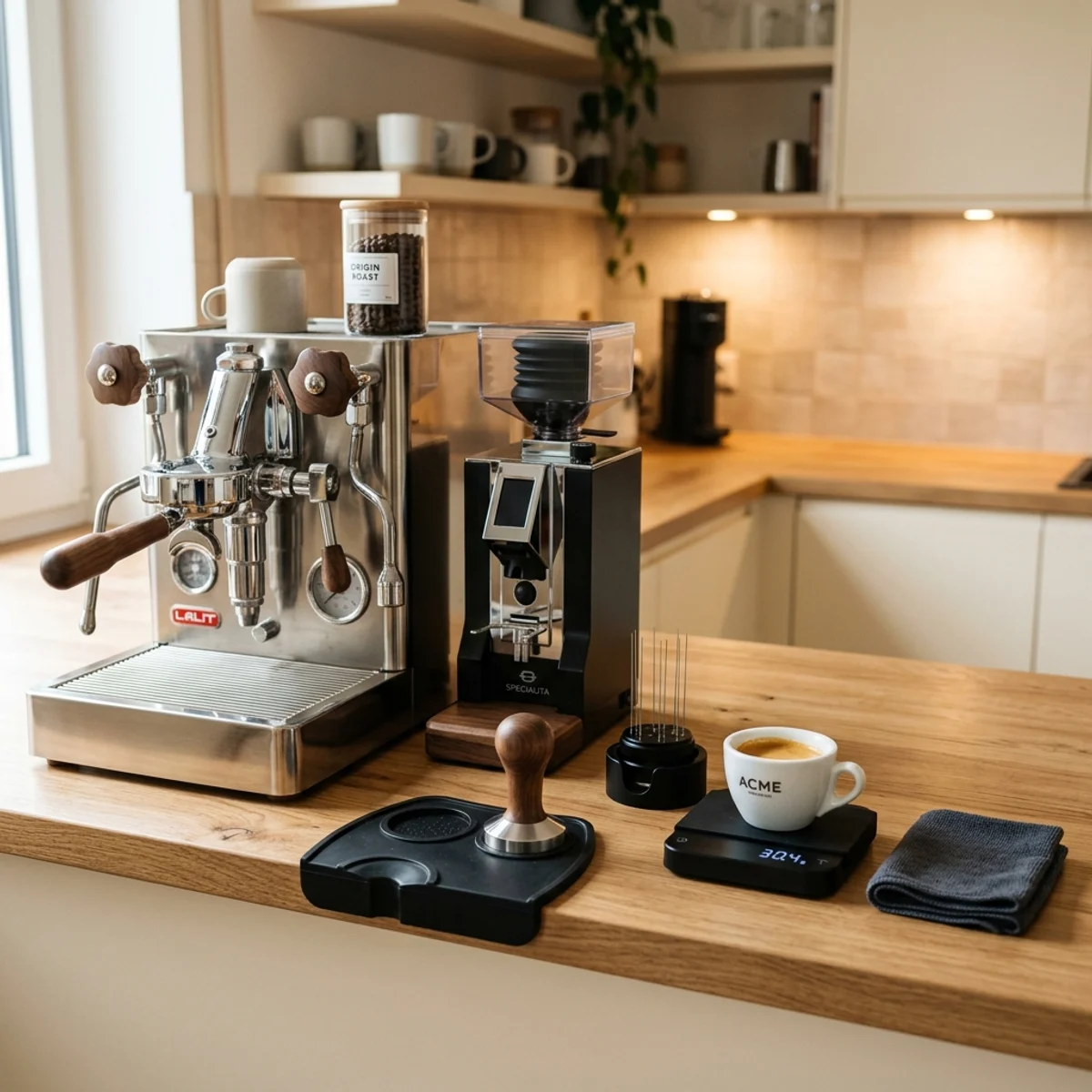
Exhaustive Technical Evaluation
The 7 Critical Filters of the Buyer’s Checklist
Review each of these blocks step by step. If a machine fails any criterion that conflicts with your kitchen layout or morning routine, eliminate it without hesitation.
Kitchen Space, Overhead Height & Ergonomics
Dimensions that product brochures omit: water tanks, levers, and daily cleanups
The most frequent mistake beginner espresso enthusiasts make is measuring only counter width. However, an espresso machine demands a much wider operating footprint than a passive countertop appliance:
- The top-loading water tank trap: Most mid-range and prosumer semiautomatic machines (such as the Rancilio Silvia, Lelit Mara, or Gaggia Classic) are refilled via a top-access flap at the rear. If your upper kitchen cabinets hang 45–50 cm (18–20 inches) above the counter, you will not be able to pour water in without sliding a heavy 10–15 kg (22–33 lb) metal machine forward every single morning. Verify whether the tank slides out from the front, from the side, or requires at least 20 cm of overhead clearance.
- Portafilter locking radius and tamping clearance: Locking the portafilter into the group head requires a 90° swinging rotation to the right with noticeable torque. You need at least 10–15 cm (4–6 inches) of free lateral clearance on the left and front to comfortably brace the machine without hitting walls or adjoining appliances.
- Steam wand articulation: The steam wand must swing outwards and upwards at an angle that allows slipping a 350ml or 500ml milk pitcher underneath without bumping into the countertop.
- Drip tray depth and capacity: Ultra-compact machines frequently feature shallow 100–150ml drip trays. After two group flush cycles and a portafilter rinse, the tray fills up, requiring daily trips to the sink to empty dirty water.
Kitchen Compatibility Verification:
Warm-Up Time & Your Morning Routine
Thermal mass physics: why hot water alone is not enough
A classic beginner pitfall is confusing the time it takes a boiler to heat water with the time it takes the machine assembly to reach true thermal equilibrium. Even if the heating indicator turns green within 2 minutes, if the heavy brass group head, shower screen, and portafilter are cold, they will instantly siphon 10–15 °C away from the brewing water as soon as extraction begins. The result: an underdeveloped, sour espresso shot with pale crema.
Thermoblock / ThermoJet
Representative Models: Sage The Bambino, De'Longhi Dedica EC685.
Water is pumped on demand through heated internal stainless steel or aluminum spirals via high-power coils. They do not store sitting water. Ideal if you wake up with tight morning routines and need a top-quality coffee in under 60 seconds.
Single Boiler
Representative Models: Gaggia Classic Evo Pro, Lelit Anna PL41TEM.
An internal brass or stainless steel boiler (200–300 ml) heats the group head. The portafilter must remain locked into the group from power-on to heat via conduction. Offers great stability once up to temp, but requires some foresight.
Commercial E61 / Dual Boiler
Representative Models: Lelit Mara X, Rocket Appartamento, Sage Dual Boiler.
The iconic E61 group contains 4.5 kg (10 lbs) of solid forged brass circulating a continuous thermosiphon loop. Its thermal inertia is unmatched, but it demands turning the machine on 30 minutes in advance (commonly via a smart WiFi plug).
Morning Routine Verification:
Thermal Architecture vs. Your Usual Drinks
Thermoblock, Single Boiler, HX, or Dual Boiler: steam thermodynamics
Espresso brewing and milk steaming operate at opposing thermodynamic states: espresso extracts with liquid water at roughly 92–94 °C (198–202 °F) and 9 bars of pressure, whereas milk texturing requires dry steam at over 125–135 °C (257–275 °F) and 1.2–1.5 bars. How a machine manages these two temperatures dictates how many cappuccinos you can craft without pulling your hair out:
| Heating System | Warm-Up Time | Simultaneous Brew & Steam | Consecutive Milk Drinks | Thermal Stability | Price Range | Example Models |
|---|---|---|---|---|---|---|
| Single Thermoblock | 3 to 40 s | No (fast mode switch) | 1 to 2 cups (modest steam pressure) | Good with digital PID control | $150 – $450 | Sage Bambino / Dedica |
| Single Boiler | 10 to 15 min | No (must heat up & flush) | 1 cup (slow for 2+ consecutive) | High with PID / Subject to surfing with thermostat | $450 – $700 | Gaggia Classic Evo / Silvia |
| Heat Exchanger (HX) | 20 to 30 min | Yes (steam boiler with heat exchange tube) | Virtually unlimited for home use | High (requires cooling flush or coffee priority mode) | $1,000 – $1,600 | Lelit Mara X / Appartamento |
| Dual Boiler | 10 to 25 min | Yes (2 independent boilers) | Unlimited (continuous commercial throughput) | Ultimate (independent PID control) | $1,200 – $3,000 | Sage Dual Boiler / Silvia Pro X |
On traditional single-boiler machines without PID control, steaming milk leaves the boiler sitting at ~130 °C. If you immediately brew another espresso, boiling water will scorch the coffee grounds. You must run water through the steam wand until the heating element light cycles back on—a noisy, unpredictable process that turns entertaining guests into a stressful chore.
Drink Workflow Verification:
The 50/50 Budget Rule & Hidden Setup Costs
The machine only pushes water; the grinder creates the espresso
The golden rule of home espresso: reserve at least 40% to 50% of your total budget for a dedicated grinder and essential barista accessories. A $1,500 prosumer machine paired with a blade grinder or a cheap spice mill will produce undrinkable coffee. Conversely, a modest $200 machine paired with a precision stepless burr grinder will consistently deliver sweet, rich espresso from specialty coffee beans.
For complete pricing tiers and realistic setup cost calculations, read our comprehensive breakdown on how much a home espresso setup actually costs.
⚖️ Precision Digital Scale (0.1g)
Estimated Cost: $20 – $40
In espresso, a 0.5-gram dose variation alters shot time by 6 seconds. You need a compact scale with 0.1g accuracy and an integrated timer to dial in brew ratios (e.g., 18g coffee in for 36g liquid out in 27 seconds, as detailed in our step-by-step espresso recipe guide). Look into models like the Bagail digital coffee scale.
🔨 Solid / Self-Leveling Tamper
Estimated Cost: $25 – $50
Plastic tampers included inside machine boxes should head straight to recycling. You need a solid stainless steel tamper with a flat base that fits your basket precisely (51.35mm, 53.3mm, or 58.5mm). Explore our picks in best espresso accessories.
🪡 WDT Tool (Distribution)
Estimated Cost: $10 – $20
Finely ground espresso builds electrostatic clumps as it exits grinder chutes. A Weiss Distribution Technique (WDT) tool with ultra-thin needles (0.3–0.35mm) de-clumps the coffee bed, reducing channeling by over 80%.
🥛 Stainless Milk Pitcher (350ml / 12oz)
Estimated Cost: $15 – $25
Crafted from surgical-grade stainless steel with a sharp spout for pouring latte art. A 350ml size is ideal for texturing 150–180ml of milk without waste, facilitating the vortex needed for silky microfoam.
Budget Balance Verification:
Portafilter Diameter & Upgrade Ecosystem
51mm, 54mm, or commercial 58mm: puck aspect ratio and accessory compatibility
Portafilter diameter is far more than an aesthetic detail: it dictates the geometric aspect ratio of your coffee puck (height versus width) as well as third-party component availability:
Entry-Level Sizing
Examples: De'Longhi Dedica, Krups Virtuoso, budget generic machines.
Being narrower, a standard 14–16g dose produces a tall, deep puck. Deeper coffee pucks present higher hydraulic resistance, making them prone to water channeling (channeling). Precision competition baskets are scarce. Check our espresso accessory compatibility guide.
Optimized Domestic Standard
Examples: Sage The Bambino, Bambino Plus, Barista Express.
Pioneered by Breville/Sage specifically for home kitchens. Offers an excellent puck geometry for 16g to 19g doses without requiring the vast thermal mass of commercial catering groups. Supported by an extensive ecosystem of calibrated tampers (53.3mm), blind discs, and IMS Nanotech competition baskets.
Commercial Specialty Standard
Examples: Gaggia Classic Evo, Rancilio Silvia, Lelit, E61.
The universal standard found in the world’s leading espresso bars. Wide, shallow puck geometry allows even water percolation. Instant access to hundreds of competition baskets (IMS, VST, Pullman), bottomless portafilters in custom hardwoods, and 58.5mm precision tampers.
Pressurized baskets feature a false bottom with a single pinhole that artificially restricts water flow to create thick mechanical froth, tolerating pre-ground grocery coffee. Unpressurized baskets feature hundreds of laser-cut precision holes: they demand an accurate burr grinder to create resistance through particle size, but they are the only baskets capable of extracting the authentic origin notes, natural oils, and true crema of specialty coffee.
Group Head Sizing Verification:
Water Hardness, 3-Way Solenoid Valve & Maintenance
90% of espresso machine breakdowns stem from limescale and rancid coffee oils
An espresso machine is a high-precision plumbing circuit subject to temperatures exceeding 100 °C (212 °F) and pressures reaching 9 to 15 bars. Ignoring water chemistry and preventive maintenance will ruin your machine within 18 months:
- Soft water as life insurance: Tap water across much of the US and Europe contains heavy concentrations of calcium and magnesium that precipitate onto heating elements and seize solenoid valves. Always feed your machine with ion-exchange filtered water (BWT magnesium filters, ZeroWater blended with mineral drops) or bottled water with total hardness between 35 and 85 ppm CaCO₃. Read our definitive guide on the best water for brewing coffee.
- The indispensable 3-way solenoid valve: Standard on machines like the Gaggia Classic or Sage Bambino Plus, but absent in budget supermarket machines. This valve instantly relieves group head hydraulic pressure right into the drip tray when you stop extraction. Its two major benefits are:
- Dry, clean puck: When unlocking the portafilter, the coffee puck knocks out in a clean, solid cake without soupy standing water.
- Enables backflushing: You can insert a blind rubber disc with specialized espresso detergent (like Cafiza) to flush cleaner back through the group head plumbing, scrubbing away oxidized, rancid oils. Check our guide on espresso machine cleaning and maintenance.
Maintenance Protocol Verification:
Learning Curve & Barista Routine Commitment
Are you seeking a rewarding new culinary hobby or simply a quick cup of coffee?
A manual or semiautomatic espresso machine is not a passive push-button convenience appliance; it is a culinary discipline that rewards curiosity and punishes haste. To consistently pull cafe-quality espresso shots at home, you must be willing to:
- Weigh your coffee bean dose to 0.1g accuracy for every single shot.
- Adjust your grinder setting in microns whenever changing bean bags or as ambient humidity shifts.
- Distribute with a WDT tool and tamp with consistent level firmness.
- Purge the group head and wipe down the steam wand immediately after each service.
If the idea of cleaning up coffee grounds and dialing in grind sizes feels overwhelming on sleepy weekday mornings, a semiautomatic machine will end up abandoned on your counter. In that case, a quality superautomatic bean-to-cup machine that grinds, tamps, and brews at the touch of a button, or a clean manual pour-over method like an AeroPress or V60, will provide a vastly more enjoyable morning experience. For more on this dilemma, explore our breakdown comparing manual espresso machines vs. superautomatics.
Routine Commitment Verification:
Decision Framework
Decision Matrix: Which Espresso Machine to Buy Based on Your Checklist
Match your 7-filter checklist results against the 5 most common buyer profiles and their benchmark models on the market.
| Buyer Profile | Space & Routine | Machine Budget | Recommended Model | Key Strengths | Tradeoffs / Limitations |
|---|---|---|---|---|---|
| 1. Compact Space + Tight Budget | Small kitchen, <5 min morning routine | < $200 / 200 € | De'Longhi Dedica EC685 | Only 15 cm (6 in) wide, fast thermoblock, affordable replacement parts | 51mm portafilter, panarello wand needs modding, no 3-way solenoid valve |
| 2. Fast Mornings + Silky Lattes | Quick routine, daily high-quality milk drinks | < $400 / 400 € | Sage The Bambino | ThermoJet ready in 3s, 9-bar OPV, 54mm group, commercial-style steam wand | Lightweight chassis requires holding machine when inserting portafilter |
| 3. Commercial Purist + Extreme Durability | Appreciates classic rituals, eager to learn | ~$450 – $550 | Gaggia Classic Evo Pro | Commercial 58mm brass group, 3-way solenoid valve, built to last decades | 12 min warm-up, requires temperature surfing without aftermarket PID |
| 4. All-in-One Convenience Solution | Wants espresso without buying separate grinder | ~$600 – $800 | Sage Barista Express Impress | Integrated grinder with assisted lever tamping, rapid thermoblock, PID | Larger counter footprint; if grinder breaks, entire machine is affected |
| 5. Advanced Barista / Dual Boiler or HX | Multiple back-to-back lattes, maximum stability | > $1,000 / 1.000 € | Lelit Mara X / Sage Dual Boiler | Simultaneous brew & steam with commercial power, dual PID, quiet pump | Significant financial investment, heavy footprint (>15 kg), 20–30 min warm-up |
Looking to compare the nuanced features of each machine? Read our detailed guide on the best value-for-money espresso machines and our roundup for absolute espresso beginners.
Beware of Deceptive Marketing
Red Flags: What NOT to Buy in Home Espresso
Steer clear of these four widespread commercial traps in general appliance retail:
The «15 or 20 Bar Pump» Marketing Gimmick
Any cheap vibration pump can produce 15 bars at zero flow. The global standard for sweet, balanced espresso extraction is exactly 9 bars. If a machine lacks an Over-Pressure Valve (OPV) to cap force at 9 bars, it will subject the coffee puck to violent hydraulic pounding, causing channeling and a bitter, burnt taste.
Steam Wands with Plastic «Panarello» Sleeves
These are thick plastic tubes with side air holes designed to forcibly inject large air bubbles. They produce stiff, soap-bubble froth that separates from the liquid coffee, making it impossible to texture the glossy, velvety microfoam required for flat whites or latte art.
No-Name Generic Brands Without Spare Parts
Budget department store machines that look like a bargain at $70. The day a shower screen gasket cracks or a portafilter ear bends, you will find no replacement parts or authorized service technicians. The entire appliance ends up in an e-waste landfill.
Internal Plastic Tubing in Pressurized Hot Zones
Machines where 95 °C water travels under pressure through low-grade thermoplastic tubes rather than food-grade copper, brass, stainless steel, or reinforced PTFE tubing. This degrades espresso flavor and causes micro-cracks and leaks within 12 to 18 months.
Frequently Asked Questions
Common Questions When Buying a Home Espresso Machine
Straightforward, engineering-backed answers to the most common dilemmas surrounding thermal systems, maintenance, and long-term performance.
Is a pressure gauge strictly necessary on a home espresso machine?
It is not strictly essential, although it serves as a valuable diagnostic tool for detecting grind issues or channelling. The pressure gauge needle visually indicates whether the coffee puck offers proper hydraulic resistance (the sweet spot sits around 9 bars). However, what truly determines in-cup extraction quality is not the aesthetic needle on the front panel, but whether the machine internally houses a factory-calibrated Over-Pressure Valve (OPV) limiting brewing force to 9 bars. Budget machines lacking an OPV may feature a gauge spiking to 15 bars, which fractures the puck and produces harsh bitterness. Between a machine with a gauge but no OPV and one with a 9-bar OPV without a gauge, always choose the latter.
Why are 58mm portafilter machines generally more expensive than 54mm models?
The price difference is a matter of thermal physics and commercial engineering rather than branding. The 58mm diameter is the worldwide commercial specialty coffee standard: heating and thermally stabilizing a forged brass or solid stainless steel group head and portafilter of these dimensions requires larger boilers, higher wattage, and massive thermal inertia (often exceeding 4 kg of brass, as seen in the legendary E61 group). In contrast, 54mm systems (typical of Sage/Breville) or 51mm machines (like the De'Longhi Dedica) use continuous thermoblocks or compact boilers, which are lighter, faster, and cheaper to produce. In exchange for a higher upfront investment, the 58mm standard unlocks access to the professional competition basket ecosystem (IMS, VST, Pullman), precision distribution tools, and standard bottomless portafilters.
What is temperature surfing and how does a PID controller prevent it?
Temperature surfing is a manual workaround practiced by home baristas on traditional single-boiler machines equipped with mechanical bimetallic thermostats. These thermostats have a wide hysteresis band: the heating element does not kick back on until water temperature drops 8 °C to 12 °C below the set point. To brew at the recommended ~93 °C (~200 °F), users must flush boiling water blindly and time heating indicator light cycles. A PID (Proportional-Integral-Derivative) controller eliminates this guesswork by replacing the thermostat with an electronic sensor and an algorithm-driven microprocessor that pulses power in milliseconds, maintaining brew temperature within ±0.5 °C to ±1 °C of precision.
Can I descale my espresso machine with ordinary household white vinegar?
Absolutely not. Household white vinegar contains acetic acid, a harsh corrosive agent that attacks and dries out flexible silicone and EPDM rubber gaskets throughout the hydraulic circuit, while corroding aluminum inside thermoblocks and boilers. Furthermore, acetic acid embeds a sharp, sour residual smell and taste deep into metal pores and internal copper lines, proving nearly impossible to flush out even after dozens of rinse cycles. For safe and thorough descaling, always use dedicated espresso descalers formulated with citric acid or lactic acid, which dissolve calcium carbonate buildup without degrading internal metals or altering coffee flavor.
Does a brass boiler machine last longer than a stainless steel thermoblock?
Both architectures offer distinct engineering benefits. Solid brass boilers (standard in workhorses like the Rancilio Silvia or Gaggia Classic) boast exceptional thermal mass and decades-long mechanical repairability: it is common to find 15- to 20-year-old brass machines operating flawlessly with routine gasket replacements and standard maintenance. On the other hand, modern thermoblocks featuring internal stainless steel tubing (as engineered by Sage or De'Longhi) offer crucial conveniences for modern households: they reach brewing temperature within seconds (3 to 30 seconds) and, because they do not store standing pools of hot water, accumulate far less limescale over time. When fed with soft water, both systems are durable, but brass boilers provide unmatched long-term rebuildability.
Recommended Next Step
Calculate the Realistic Cost of Your Complete Coffee Station
Do not let unexpected expenses catch you off guard. Discover realistic budget breakdowns for beginner, intermediate, and advanced home espresso setups combining machine, grinder, and barista tools.